Bulgaria Digital Nomad Visa Guide for 2026

Does Bulgaria have a digital nomad visa? Yes, as of December 2025, Bulgaria introduced a visa for remote workers, a residence permit for non-EU/EEA citizens. This allows them to live in the country while working online for foreign clients or employers.
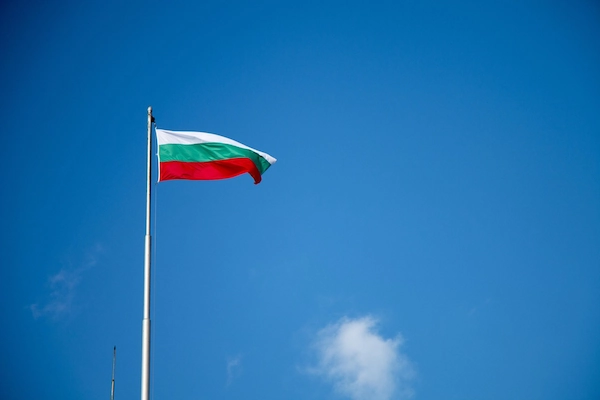
This guide will provide you with essential information about Bulgaria’s visa for freelancers, including eligibility requirements and the application steps.
Table of contents
- New Bulgaria’s digital nomad visa explained
- Bulgaria vs other European digital nomad visas
- Bulgaria’s digital nomad visa requirements
- Step-by-step application process
- Documents required for Bulgaria’s digital nomad visa application
- Bulgaria’s visa photo requirements
- Online visa photo maker
- Bulgaria’s digital nomad visa fees
- Duration, extensions & renewal
- Bulgaria’s digital nomad visa tax considerations
- FAQ
New Bulgaria’s digital nomad visa explained
In December 2025, Bulgaria officially opened a legal pathway for remote professionals who earn income from abroad and want to live in the EU. Below, we explain who the visa is designed for and what its main characteristics are.
Key features:
- Established residence categories for remote employees, owners/managers of foreign companies, and freelancers with overseas clients.
- Set income requirement of 50 times the monthly minimum wage (approximately €27,500–€31,000 annually), and an initial one-year permit is offered, with the possibility of one renewal for a total of two years.
- Strict prohibition on working for Bulgarian employers or clients.
- A two-phase application process: obtain a Type D visa from abroad, then apply for a residence permit in Bulgaria within 14 days of arrival.
Who qualifies:
- Remote employees: Must work for a company registered outside the EU, EEA, and Switzerland, fully remotely, and meet the salary criteria.
- Business owners/managers: Should own at least 25% of a foreign company or hold a management position, performing their duties remotely.
- Freelancers/independent professionals: Must have provided digital or remote services only to foreign clients for at least a year prior to applying.
What the permit allows and restricts:
- Allows residency in Bulgaria, housing rentals, and remote work for foreign entities.
- Typically permits family members to join through family reunification, as per relevant rules.
- Post-Schengen accession, long-term residents gain Schengen-area short-stay travel rights, though specific mobility rights depend on the residence permit type.
- Does not allow local employment, invoicing Bulgarian clients, or failing to meet income and insurance requirements. Non-compliance may lead to denial of renewal or cancellation.
This permit is exclusively for non-EU/EEA/Swiss nationals. EU and EEA nationals can rely on free movement laws rather than this program.
Bulgaria vs other European digital nomad visas
European digital nomad visas vary widely in cost, income thresholds, and tax exposure. Here you’ll see how Bulgaria compares to popular options such as Portugal, Spain, Croatia, and Estonia in terms of affordability, flexibility, and long-term benefits.
Bulgaria’s Digital Nomad Visa is considered one of the easiest in Europe, offering a cost-effective and tax-friendly option. With income requirements comparable to Italy but significantly lower than Portugal, Spain, Estonia, and Croatia, Bulgaria also boasts one of the lowest flat tax rates in Europe at 10%. While it may not offer as clear a path to long-term residency as Spain or Portugal, Bulgaria is an attractive choice for a 1-2 year stay due to its affordable living costs and streamlined bureaucratic processes.
The table below provides a side-by-side comparison of the Schengen Digital Nomad Visas:
| Country | Min. income (approx.) | Duration & renewals | Local tax headline | Path to PR/citizenship |
|---|---|---|---|---|
| Bulgaria | €23,800 – €27,500/year (≈50× minimum wage) | 1 year, typically renewable once (≈2 years total) | 10% flat personal income tax once tax-resident (>183 days) | No explicit PR track via DNV yet; separate routes exist, but DNV is framed as temporary |
| Italy | ≈€28,000/year base; more if with family | 1 year, renewable; can convert to longer-term permits in some cases | Progressive up to 43%, but special regimes are possible depending on the structure | Clearer path via long-stay permits and later EU long-term residence/citizenship |
| Portugal (D8) | ≈€3,480/month (4× min. wage) | 1–2 year card, then 3-year cards, up to 5 years total | Progressive rates; special reduced regime for some newcomers | Solid 5-year PR and citizenship track if residency is maintained |
| Spain | ≈€2,646/month (200% min. wage) | 1 year, renewable up to 5 years | “Beckham” regime: 24% on income up to €600k for a period | Path to PR and then citizenship after long-term residence |
| Croatia | ≈€2,539/month | Up to 1 year; generally non-renewable/limited repeats | Tax residency after 183 days with progressive rates 9–44% | No direct PR path from DN status |
| Estonia | ≈€3,504/month | Up to 1 year, non-renewable | Usual Estonian tax rules if tax-resident; the corporate deferral regime is separate | No residency path from DN visa alone |
Bulgaria’s digital nomad visa requirements
Eligibility depends on meeting clear legal and financial conditions set by Bulgarian authorities. Here, we break down the Bulgaria Digital Nomad Visa income requirements and other core criteria you must satisfy before applying.
The primary requirement is financial. Applicants must prove an average annual income of at least 50 times Bulgaria's minimum monthly salary, approximately BGN 1,213 (around EUR 627) as of January 2026.
Essential eligibility criteria include
Nationality and work status:
- Open to non-EU/EEA/Swiss citizens only.
- Must work remotely and earn income from outside Bulgaria (foreign employers, foreign companies, or foreign clients only).
Professional categories:
- Remote employees of companies registered outside the EU/EEA/Switzerland.
- Owners/managers with at least a 25% stake in a foreign-registered company serving non-Bulgarian markets.
- Freelancers/independent professionals with at least one year of service to foreign clients with no Bulgarian clients.
Step-by-step application process
The application for Bulgaria’s remote worker visa involves two stages: obtaining a Type D long-stay visa and then securing a digital nomad residence permit upon arrival in Bulgaria. Here’s a step-by-step guide for non-EU/EEA citizens working remotely for foreign clients or employers:
Before entering Bulgaria:
- Gather necessary documents.
- Apply for a long-stay Type D visa at a Bulgarian embassy or consulate in your home country or country of residence:
- Schedule an appointment, often available online, at the Bulgarian embassy/consulate.
- Submit the Type D visa application form, pay the fee, and provide all required documents for the digital nomad category. You may need original documents, copies, translations, and apostilles as necessary.
- Await the decision, which typically takes 4–8 weeks, though this may vary based on consular workload.
- Once approved, your passport will receive a Type D visa, granting entry to Bulgaria for the purpose of obtaining a residence permit.
Upon arrival in Bulgaria:
- Secure long-term accommodation if only a short-term booking was used for the visa, and acquire a lease or notarized declaration from the landlord, as a registered address is necessary for the residence permit.
- Within 14 days of entering, apply for a residence permit under the Digital Nomad Visa program at the local Migration Directorate office corresponding to your address:
- Complete the residence-permit form under the Digital Nomad category and provide your passport, Type D visa, photos, proof of income, remote work documentation, criminal record (if still required), health insurance, and proof of accommodation.
- Pay the residence permit issuance fee.
- Once approved, you’ll receive a residence card valid for up to one year under the Digital Nomad scheme.
Documents required for Bulgaria’s digital nomad visa application
To apply for Bulgaria’s freelance professional visa, you need to prepare two sets of documents: one for the Type D visa at the consulate and another for the residence permit in Bulgaria. Much of the documentation overlaps between the two. Here’s a checklist of what you need:
- Valid passport with a copy of the bio-data page, and any previous Bulgarian visas, if applicable.
- Completed Type D visa application form for the consulate and later, the residence permit form in Bulgaria.
- A recent passport-sized photo in full color that adheres to standard visa photo requirements.
- Receipt of the visa fee payment.
- Proof of remote employment or work for foreign entities:
- Employees: Employment contract and/or a letter from your employer confirming fully remote work and the company’s foreign registration.
- Business owners: Company registration documents and proof of being a shareholder or manager (at least 25% ownership) in a foreign-registered company conducting business outside Bulgaria.
- Freelancers: Contracts, platform statements, or invoices indicating at least one year of services provided to foreign clients.
- Evidence of meeting the minimum annual income requirement, such as pay slips, tax returns, or bank statements.
- Clean criminal record certificate from your country of nationality or legal residence, often required to be apostilled and translated into Bulgarian.
- Proof of accommodation in Bulgaria, like a rental contract, hotel booking, or property deed.
- International health insurance that is valid in Bulgaria and throughout the Schengen/EU area for the entire duration of your stay.
- For dependents who plan to join you later, you’ll need a marriage certificate, birth certificates, and proof of relationship, all apostilled or legalized and translated as necessary.
Bulgaria’s visa photo requirements
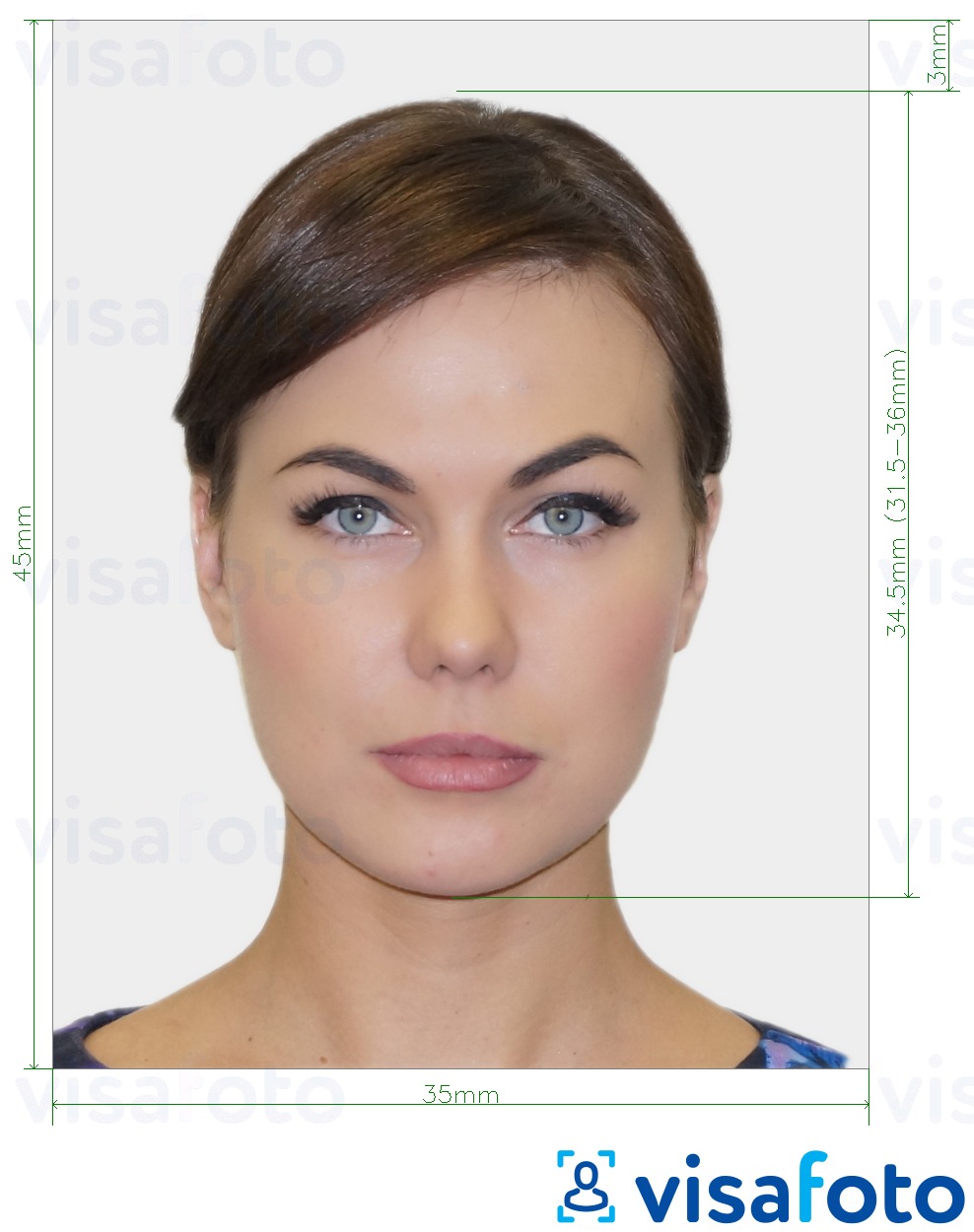
Your application photo must meet official biometric standards to be accepted. Here are the specifications required by Bulgarian authorities:
- The photo should measure 35 mm wide by 45 mm high (3.5 × 4.5 cm).
- Your head should be about 30 mm from the bottom of the photo and occupy 70–80% of the image.
- Digital specifications: Minimum pixel resolution at 600 DPI, typically 826 × 1062 pixels. File size should be under 120 KB, in JPG, JPEG, or PNG format.
- Use a plain, light-colored background, typically white or light grey. No patterns, objects, or shadows visible.
- Face the camera directly with a clear and unobstructed view of your face.
- Hats or head coverings are prohibited unless worn for religious purposes.
- Glasses are allowed if they don’t cause glare or shadows and don’t hide the eyes. Tinted glasses or sunglasses are unacceptable.
- The photo should be taken within the last 6 months to accurately depict your current appearance.
Here is a photo example:
Online visa photo maker
Read on to find out how to take a professional visa photo that will be accepted by the Bulgarian authorities.
Taking a high-quality photo for the Bulgarian visa is much easier with today's online tools. Visafoto, a reliable photo editing service, simplifies the process in just two steps:
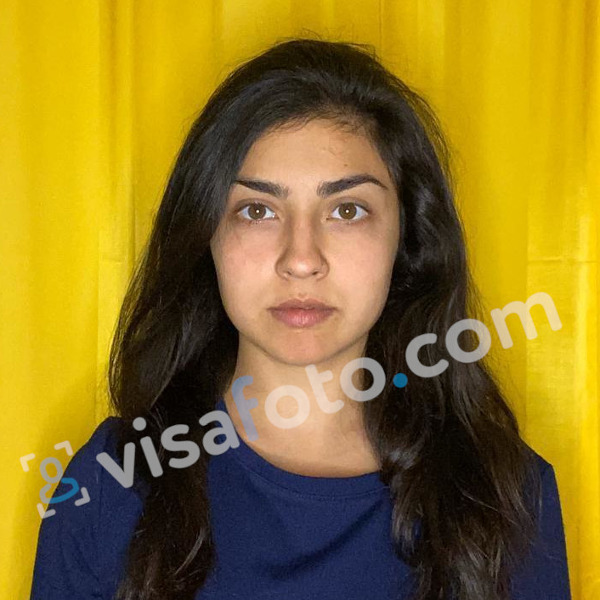
- Upload a photo taken in daylight to the Visafoto tool below.
- Select the country and document type (e.g., Bulgaria, visa).
Visafoto automatically adjusts the photo to meet official standards, resizing and aligning the head position as needed. It provides both digital copies for online submissions and prints.
Here is an example of a photo that you can upload to Visafoto:
Result by Visafoto:
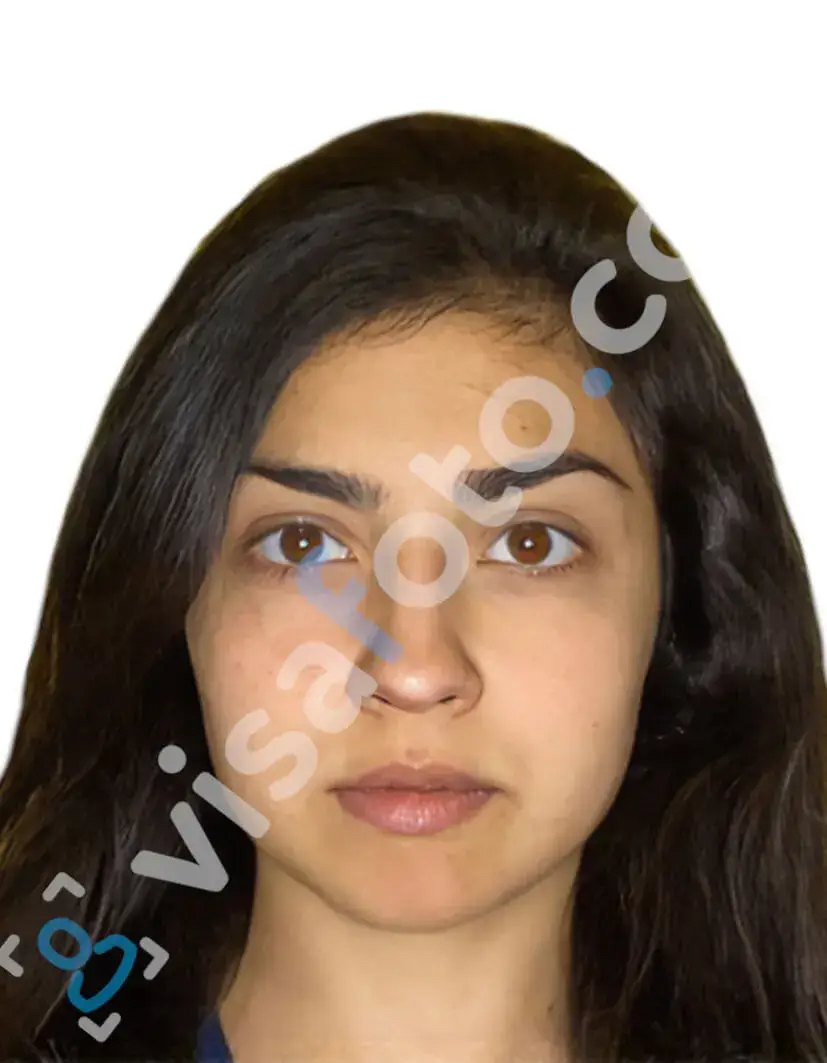
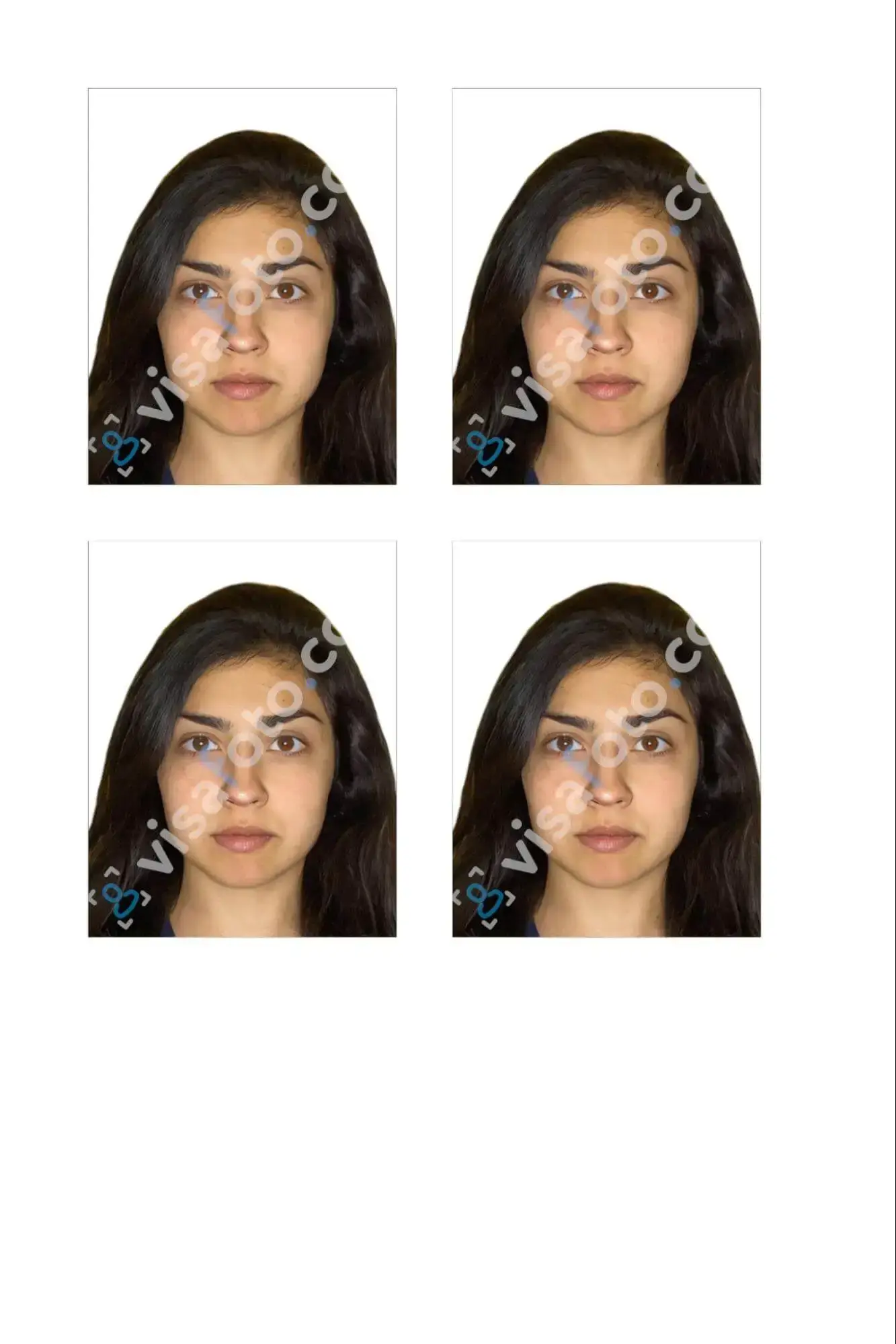
Visafoto boasts a 99.7% acceptance rate, with more than 1,000,000 photos accepted by government authorities, guaranteeing compliance or your money back. Access 24/7 tech support for assistance.
Bulgaria’s digital nomad visa fees
By EU standards, Bulgaria’s freelance visa is relatively inexpensive: you pay once for the long-stay (Type D) visa at the consulate and then again in Bulgaria for the residence permit card, plus additional costs such as translations and insurance. Here is the cost breakdown.
Applying for Bulgaria's Visa D requires a standard consular fee of approximately €100. Once you arrive, expect the Digital Nomad residence permit and card issuance to cost around €150–€200, covering state fees and card production.
Duration, extensions & renewal
Bulgaria’s visa for remote workers is issued for a fixed period but can be extended under certain conditions. Here you’ll learn how long you can stay and when to apply for renewal.
The digital nomad residence permit in Bulgaria is initially valid for 12 months, granted once you enter the country on a Type D visa and complete your residence application. You can renew this permit once for an additional 12 months, allowing a maximum stay of approximately 2 years under this status.
Renewing your permit requires reaffirming that you meet all eligibility criteria. Be sure to apply for renewal before your current permit expires.
After the 2-year period (1+1 years), you must either leave Bulgaria or transition to another eligible residence category, such as work, business, family, or study, each with its distinct requirements.
Bulgaria’s digital nomad visa tax considerations
Bulgaria boasts one of the most attractive personal income tax systems in the EU. It has a flat income tax rate of 10%, with no progressive scaling. Read on to find out about freelance tax in Bulgaria.
You are generally considered a tax resident in Bulgaria if you spend over 183 days there within any 12-month period, or if your “center of vital interests” is in Bulgaria. As a tax resident, your global income - not just income sourced in Bulgaria - falls under Bulgaria’s personal income tax regulations.
Bulgaria has treaties to avoid double taxation with many countries, often allowing for foreign tax credits or exemptions to prevent being taxed twice on the same income. However, countries like the United States tax their citizens on worldwide income regardless of residency, meaning U.S. citizens might still need to file and potentially pay taxes in the U.S. after becoming Bulgarian tax residents.
Good luck with your visa application!
FAQ
Can I apply for the Bulgarian digital nomad visa as a freelancer with multiple foreign clients?
Certainly. As a freelancer with multiple non-Bulgarian clients, you can apply. Ensure you have evidence of at least one year of such work and meet the income requirement, which is 50 times the Bulgarian monthly minimum wage - approximately €27,500 to €31,000, depending on the reference year.
Is passive income (dividends, investments) accepted for the digital nomad visa?
Passive income, such as dividends and investments, is not sufficient. The visa requires active remote work with foreign income aligning with the 50 times minimum wage criterion. While passive income can enhance your financial standing, it does not meet the main condition of ongoing remote work for non-Bulgarian clients or employers.
Can I apply for the Bulgaria digital nomad visa from inside the country?
No, you cannot apply from within Bulgaria. You must secure a Type D long-stay visa at a Bulgarian embassy or consulate in your home country or country of residence before entering Bulgaria. Once there, you have 14 days to apply for the residence permit at the local Migration Directorate.
Is a Type D visa mandatory before applying for the residence permit?
Yes, you need a Type D long-stay visa before applying for the Digital Nomad residence permit. Obtain it from a Bulgarian embassy or consulate outside of Bulgaria.
Is self-employment allowed under the Bulgarian digital nomad residence permit?
Yes, self-employment is permitted. The permit specifically allows freelancers and independent professionals who have worked remotely for foreign clients for at least one year prior to applying, as long as there are no Bulgarian clients involved.
Can family members accompany the nomad?
Yes, family members such as a spouse and dependent children can join the digital nomad. They must go through family reunification, which requires their own documents and adherence to Bulgarian immigration requirements.
Is local employment allowed?
No, local employment is prohibited under the Digital Nomad residence permit in Bulgaria. You must work solely for foreign employers or clients and avoid any employment with Bulgarian entities.
Can nomads travel within the EU with this status?
Yes, holders of Bulgaria’s Digital Nomad residence permit can travel short-term within the Schengen Area for up to 90 days in any 180-day period. Bulgaria joined the Schengen Area in 2025, allowing permit holders to enjoy EU long-stay residence travel rights.