How to register a foreign minor with AIMA: photo and document guide
Foreign minors in an irregular situation in Portugal can be registered with the Agency for Integration, Migration and Asylum (AIMA) so that they can access healthcare and education. A parent or legal guardian requests the registration by emailing the required documents, including a current photograph of the child, to registo.menores@aima.gov.pt.
This guide explains who can request AIMA registration for a foreign minor, which documents are required, how to prepare and send the files, and what happens after submission. It also covers the child's photo, how Visafoto can help prepare it, the purpose and validity of the resulting credential, and the difference between this registration and a Portuguese residence permit.
Contents:
- What is the AIMA Registration of Foreign Minors?
- Who can request the registration?
- Documents required by AIMA
- AIMA photo requirements for a foreign minor
- Prepare a child's photo for AIMA registration online!
- How to prepare the files for submission
- How to send the request to AIMA
- What happens after the request?
- AIMA registration versus a residence permit for a child
- Frequently asked questions
What is the AIMA Registration of Foreign Minors?
The Registration of Foreign Minors, called Registo de Menores Estrangeiros in Portuguese, is a special registration for foreign children who are in an irregular situation in Portugal. Its purpose is to help the registered child access healthcare, preschool and school education.
In this context, an irregular situation generally means that the child does not currently have a valid legal basis to enter or remain in Portugal. The most relevant examples include:
- The child's visa, visa-free stay or other authorised period of stay has expired, and no valid extension or other right to remain applies.
- The child entered Portugal without meeting the applicable legal entry requirements.
- An immigration or residence application concerning the child received a final refusal, with no continuing right to remain.
- The child's residence permit was cancelled.
AIMA's instructions for this registration give an expired permission to stay as a specific example. The list above is not exhaustive, and an expired document does not always mean that the child is in an irregular situation. A pending renewal, a temporary validity rule or another legal right to remain may affect the child's status. If the position is unclear, ask AIMA to confirm which procedure applies before sending the registration documents.
Once AIMA has reviewed and approved the application, the parent or guardian receives a named document called the Registration Credential for Foreign Minors, or Credencial de Registo de Menores. It can be presented at health centres and school groupings (Agrupamentos de Escolas) as evidence of the child's registration for these specific purposes.
The registration has a deliberately limited legal purpose. Under Decree-Law No. 67/2004, it cannot be used to regularise the immigration status of the child or the adults responsible for them. The information in the register also cannot be used as grounds or evidence in proceedings against those adults, except where necessary to protect the child's rights.
The credential is therefore not a residence permit, passport or travel document. Families who need to regularise a child's stay must follow the appropriate immigration procedure separately.
Who can request the registration?
A parent or another person legally responsible for the child can request the registration when the child is a foreign minor in an irregular situation in Portugal.
This is not a general registration route for every foreign child in Portugal. It is intended for the specific registration covered by the legislation on foreign minors in an irregular situation. A child who already has valid residence status, or who qualifies for a residence permit through another route, may need a different procedure.
If you are uncertain whether the child falls within this registration scheme, contact AIMA before sending personal documents. Eligibility depends on the child's circumstances, so families should not select this route only because it is handled by email.
Documents required by AIMA
AIMA asks for documents identifying the child, proving the relationship with the parent or guardian, and identifying the adult making the request. Its official instructions for registering foreign minors list the following:
- An identification document belonging to the parent or legal guardian, such as a passport, residence permit or Portuguese Citizen Card.
- The child's passport pages showing the biographical information, visa and entry stamp for Portugal or another European Union country, where applicable.
- The child's birth certificate or another document proving parentage, such as an identity card from the country of origin or a consular card.
- A current photograph of the child. AIMA states that this photograph may be taken with a mobile phone.
The documents must be digitised and saved as separate files. AIMA's checklist should be followed as published rather than replaced with documents that appear similar. If a required document is unavailable, ask AIMA what can be accepted in that particular case.
AIMA's published checklist does not state that a Portuguese tax identification number, or NIF, must be attached to this email request. Do not add unrelated tax, residence or school records unless AIMA asks for them.
AIMA photo requirements for a foreign minor
AIMA requires a current passport-type photograph of the child. The image must be attached as a separate file from the other documents.
The following practical steps can make the child easy to identify, but they are presentation advice rather than additional AIMA rules:
- Use a recent image that reflects the child's current appearance.
- Photograph the child alone, without another person or large objects in the frame.
- Keep the child's face visible and in focus.
- Avoid strong shadows, blur and filters that change facial features.
- Choose a simple, uncluttered setting so that the child remains the main subject.
Do not reuse an old document photograph if the child's appearance has changed substantially. If the image is blurred, heavily compressed or partly covers the face, take another photograph before preparing the email.
Prepare a child's photo for AIMA registration online!
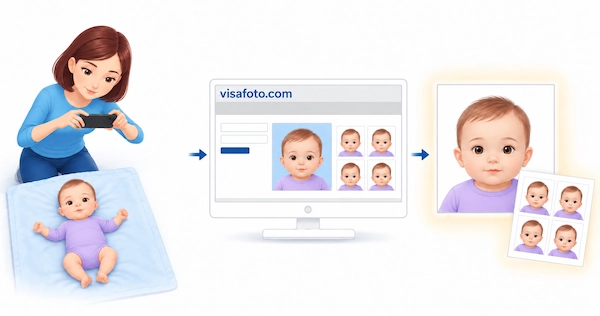
Visafoto can help turn a clear phone photograph into a neatly framed digital portrait.
To prepare the photograph with Visafoto:
- Take a clear picture of the child with a phone or camera. The source image can be taken against any background, and it does not need to look like a finished passport photo.
- Upload the picture to Visafoto.
- Let Visafoto adjust the crop, framing, background, lighting and image quality.
- Download the resulting digital portrait and check that it still represents the child's current appearance.
- Save the photograph separately from the passport and supporting documents before attaching it to the AIMA email.
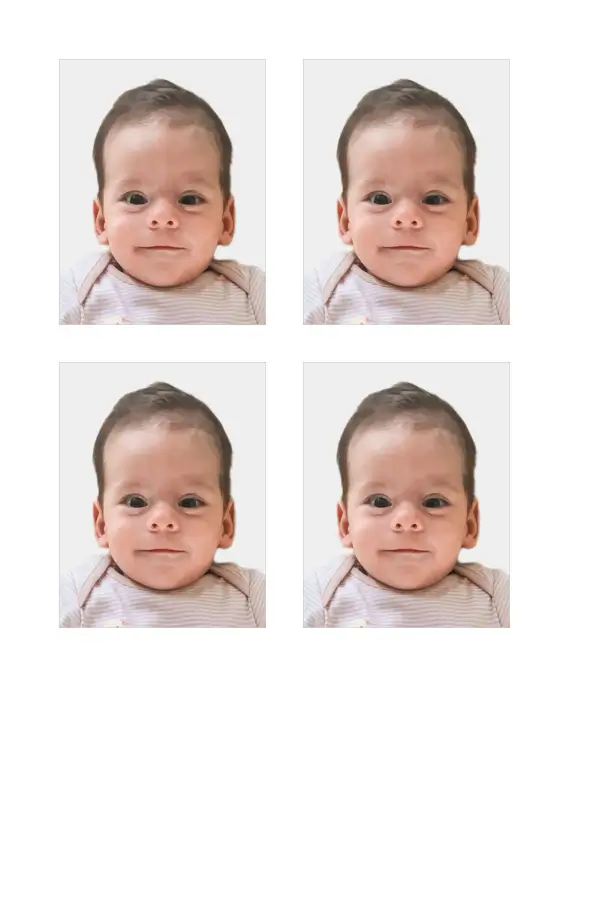
Example of the photo you can upload to Visafoto:

Result from Visafoto:

How to prepare the files for submission
Every required document should be readable and saved as its own attachment. AIMA asks applicants to digitise the documents as separate files and send them together in a single email.
Use this preparation sequence:
- Scan or photograph each document clearly, including every page needed to show the required information.
- Save the proof of parentage, child's photograph, child's passport and parent or guardian's identification as separate files.
- Open every saved file and confirm that the text, stamps and images are legible.
- Give each attachment a clear name, for example
child-photo,child-passport,birth-certificateandparent-identification. - Attach all the required files to one email.
- Review the recipient address and attachments before sending.
The example file names above are organisational suggestions, not an official AIMA naming convention. AIMA's instructions do not publish a mandatory file format, maximum attachment size or required email subject for this procedure. Do not reduce the files so aggressively that document text or the child's face becomes unclear.
How to send the request to AIMA
Send the registration request and all required attachments in one email to registo.menores@aima.gov.pt. Each document, including the child's photograph, should remain a separate file.
The message should identify the child and the parent or guardian making the request. It is also sensible to state that the email concerns a request for the Registration of a Foreign Minor, but AIMA does not publish a mandatory subject line in the available instructions.
Before sending the email:
- Check the spelling of
registo.menores@aima.gov.pt. - Confirm that all required documents are attached.
- Make sure the attachments open and are readable.
- Send the request from an email account you can continue to access.
- Retain the sent email and the final set of attachments.
AIMA may contact the sender if additional information is needed. Monitor the email account used for the request, including its spam or junk folder. Do not send identity documents to addresses copied from unofficial forums or social-media posts.
What happens after the request?
AIMA reviews the documents and the child's eligibility for this registration. If the application is approved, the parent or guardian receives the Registration Credential for Foreign Minors.
The credential can be presented at health centres and school groupings so that the child can access healthcare, preschool and school education under the registration scheme. Keep the document with the child's important records and provide it only where it is relevant to those services.
Under Ordinance No. 995/2004, the credential is valid for two years from its date of issue and can be renewed. Families should check with AIMA about renewal before the document expires, because the available instructions do not state a universal renewal window.
AIMA does not publish a fixed processing time for the email procedure. Keep the sent email as evidence of the request and monitor the account for a response rather than relying on an unofficial processing estimate.
AIMA registration versus a residence permit for a child
The Registration of Foreign Minors and a Portuguese residence permit are different procedures with different legal effects. The registration described in this guide supports access to healthcare and education, but it does not give the child legal residence.
A separate AIMA appointment route applies to certain babies and foreign minors who were born in Portugal and have a foreign parent with a residence permit. For that procedure, the parent uses AIMA's contact form, selects the residence-permit subject and the option for babies or foreign minors born in Portugal under Article 124, and attaches the documents requested for the appointment.
AIMA states that this separate request should be made within six months after the child's birth is registered. Its contact-form guidance for babies and foreign minors born in Portugal lists a Portuguese birth record and copies of the resident parent's passport and valid residence permit among the required documents.
Do not send a residence-permit appointment request to the foreign-minor registration email simply because both procedures concern children. Use the route that matches the child's circumstances and the legal result being requested.
Frequently asked questions
Who can register a foreign minor with AIMA?
A parent or another person legally responsible for a foreign minor in an irregular situation in Portugal can request the registration. If it is unclear whether the child falls within this scheme, ask AIMA before sending personal documents.
What documents are required to register a foreign minor with AIMA?
AIMA lists identification belonging to the parent or guardian, the child's passport, a birth certificate or another accepted proof of parentage, and a current photograph of the child. Each item must be saved as a separate file.
Where do I send the AIMA foreign minor registration request?
Send it to registo.menores@aima.gov.pt. Check the address carefully and do not send identity documents to an address taken from an unofficial source.
Can a child be registered without a passport?
AIMA lists the child's passport as a required document. If the child does not have one, the parent or guardian should ask AIMA what can be accepted in that individual case rather than sending an assumed substitute.
What happens after I email the documents to AIMA?
AIMA analyses the documents and the request. If it approves the registration, the parent or guardian receives the Registration Credential for Foreign Minors for use in the child's access to healthcare and education.
How long does AIMA take to process the registration?
AIMA does not publish a fixed processing time in the available instructions. Retain the sent email and monitor the account used for the request for further instructions or a decision.
What rights does the Registration Credential for Foreign Minors provide?
The credential supports the registered child's access to healthcare, preschool and school education. Its use is limited to the purposes established by the foreign-minor registration legislation.
How long is the AIMA credential valid?
The credential is valid for two years from the date of issue and can be renewed. Ask AIMA about the current renewal procedure before it expires.
Does AIMA registration give the child legal residence in Portugal?
No. The registration cannot be used to regularise the child or the adults responsible for them. A separate immigration procedure is required to obtain residence status.
Can the credential be used as a passport or travel document?
No. The credential is not a passport, travel document or residence permit. It documents the child's registration for access to healthcare and education.
Is this the same as applying for a residence permit for a child born in Portugal?
No. Certain children born in Portugal to a legally resident foreign parent have a separate residence-permit appointment route through AIMA's contact form. That process should not be confused with the email registration for foreign minors in an irregular situation.
Last updated: September 14, 2026.