Russia Work Visa for Indians in 2026: Requirements, Process, Documents, and Fees

Can Indians get work visas in Russia? Yes, if they have a valid job offer from a Russian employer. In 2026, Russia's demand for foreign labour continues to grow, driven by workforce gaps in strategic industries and strengthened labour agreements with India. As a result, the Russian work visa system has become more structured, offering defined pathways for skilled and technical specialists.

This guide is intended for Indian nationals on how to get a work permit in Russia. This includes graduates who are transitioning from student to working status, as well as professionals in the IT, healthcare, construction and manufacturing sectors who require clear explanations and which documents they need to prepare. The guide also explains where to obtain a compliant work visa photo.
Table of contents
- India–Russia labour mobility agreements
- Types of Russia work visas in 2026
- Eligibility criteria for Indian citizens
- Step-by-step application process from India
- Documents required for a work visa to Russia
- Total costs of Russian work visa for Indians
- Get your visa photo online!
- Russian work visa validity and renewal
- Post-arrival formalities in Russia
- Rights, duties and working conditions
- FAQ
India–Russia labour mobility agreements
Can Indians work in Russia? Yes, India and Russia have expanded cooperation on workforce mobility to address sector-specific labour shortages. Here we explain how these agreements affect hiring procedures and the potential impact on Indian applicants in 2026.
India and Russia signed two landmark labour mobility agreements in December 2025 — one on the Temporary Labour Activity of citizens from each state and another on Cooperation in Combating Irregular Migration — creating a formal, government-to-government framework for workforce movement. Under these accords, Russia has earmarked quotas that could see approximately 70,000 Indian workers deployed by 2027 in sectors such as construction, agriculture, IT-enabled services and light manufacturing, with contracts jointly vetted to ensure wage protection, insurance and repatriation rights.
The government-to-government route replaces ad-hoc hiring with regulated recruitment, transparent quotas, enforceable contracts and defined grievance redressal mechanisms, reducing reliance on informal agents and lowering the risks associated with irregular migration. For Indian applicants in 2026, this means safer and more predictable employment pathways into priority sectors where Russia faces acute labour shortages, backed by bilateral oversight and worker safeguards.
Types of Russia work visas in 2026
Russia offers several work visa categories depending on skill level, job duration, and employer status. Here you’ll see how standard, highly qualified specialist, and new skilled visas differ, and which option is most relevant for Indian workers.
Standard Work Visa
The standard employer-sponsored work visa begins as a single-entry visa valid for up to 90 days with an official invitation. Once inside Russia, holders convert it to a multiple-entry visa valid for up to 12 months and renewable in line with their employment contract. This route remains the main option for mid-level professionals and skilled workers who join companies following the traditional work permit and invitation process.
Highly Qualified Specialist (HQS) Visa
For highly paid specialists, Russia’s Highly Qualified Specialist (HQS) visa offers a streamlined and longer-term alternative. HQS status requires a higher salary threshold and allows employers to bypass foreign labour quotas. Successful applicants receive a multiple-entry visa valid up to three years, with extensions possible without leaving Russia. This category is increasingly preferred by experienced professionals in technology, engineering, and management roles and includes simplified procedures for work permits and family visas.
New 2026 Skilled Visa
Launching April 2026, the new Skilled Visa route expands opportunities with faster processing, broader sector coverage, and direct pathways to temporary or permanent residency without traditional quotas or language tests. The programme targets high-demand fields such as science, industry, education, and manufacturing, enabling qualified Indians to obtain residency-linked status and work rights more efficiently than under existing visa categories — a major shift in Russia’s approach to attracting foreign talent.
Eligibility criteria for Indian citizens
To qualify for a Russian work visa as an Indian citizen in 2026, you must satisfy three key requirements: have a valid job offer and invitation from Russia, meet basic personal and medical standards, and have skills and a salary that align with the specific visa type. While criteria vary slightly by visa type, the following core guidelines generally apply to Indian applicants sponsored by an employer.
Job offer and employer sponsorship:
You need a formal employment contract or job offer from either a Russian company or a foreign company authorized to operate in Russia.
Before visa application in India, the employer must secure a work permit and official invitation for you from the Russian Ministry of Internal Affairs.
Passport and age:
Your Indian passport must be valid for at least six months beyond your expected departure date from Russia, with a minimum of two blank visa pages.
Is there an age limit for Russian work visas for Indians? Russia imposes no specific maximum age for work visa applicants. The primary condition is that applicants must be adults (18 years or older) and eligible under Russian labor and migration laws.
Clean record and security checks:
Although not always mandatory, a police clearance certificate from India showing no significant criminal record is advisable, as it can streamline internal approvals.
Visa approval may be denied if you are affected by bans due to prior overstays, deportations, or appearance on sanctions lists. Consular and MVD checks might identify such issues.
Route-specific details
Standard Work Visa:
Linked to employer quotas and work permits, this visa is mainly for skilled or semi-skilled positions with salaries below HQS standards.
Initially a 90-day single-entry visa, it can be converted to a multi-entry visa in Russia, valid for up to a year and renewable for up to three years, subject to contract continuation and compliance with medical and registration rules.
Highly Qualified Specialist (HQS):
Requires significant professional qualifications and a minimum salary (generally around RUB 2,000,000 per year, with lower thresholds for certain IT and research roles).
Offers a multi-entry visa valid for up to three years, with quota exemptions and an expedited path to residency if conditions are maintained.
New Skilled Visa (Effective April 15, 2026):
Targets skilled professionals in fields like engineering, IT, manufacturing, education, and research with recognized qualifications and relevant job offers.
Allows eligible Indians to apply for three-year temporary residency, or in some cases, direct permanent residency, often without requiring language proficiency tests or facing quota limitations, provided they meet documentation and background verification criteria.
Step-by-step application process from India
Applying for a Russian work visa follows a defined sequence that starts with employer approval and ends with visa issuance. Below is a detailed guide based on the standard employer-sponsored work visa. Note that HQS and Skilled Visa routes require additional proof of salary, qualifications, and residency processing.
Here is a clear step-by-step guide:
- Receive official documents: Obtain a written job offer or contract from a Russian company authorized to hire foreign workers. The contract should clearly outline the role, salary, location, and duration.Ensure that the employer is accredited and adheres to foreign labor regulations in their region.
- Collect all necessary documents for your application.
- Complete the online visa application form at the official MFA portal.
- Schedule an appointment at a Russian Visa Application Centre (VFS) or consulate in New Delhi, Mumbai, Chennai, or Kolkata, according to your jurisdiction.
- Attend your appointment in person with your complete set of documents. Pay all necessary consular and service fees.
- Submit your fingerprints or other biometric data at the visa centre if required for your visa category or if it's your first application.
- Collect your passport with the visa upon notification.
- Register in Russia: Within seven days of arrival, your employer must register your address with the local migration authorities.
Can I apply for a Russian work visa for Indians online? You cannot obtain a Russian work visa entirely online. While the application form can be filled in online, it must still be submitted offline.
Documents required for a work visa to Russia
The exact list of documents required for a Russian work visa can vary slightly depending on the consulate and your specific visa category (Standard Work, HQS, or Skilled Visa), but most Indian applicants will need the definite core documents in 2026. Below is the list:
Essential documents:
A passport valid for at least six months beyond your planned departure from Russia, with a minimum of two blank visa pages.
A completed and signed online Russian visa application form. Submit this through the official MFA portal, ensuring consistency with your passport details.
A high-quality, passport-sized photo (35x45 mm) on a light background.
An original invitation from the Russian Ministry of Internal Affairs, requested by your host organization in Russia.
An HIV test certificate, taken within three months prior to applying.
Employment and immigration documents:
Work invitation: Obtain the original or electronic invitation from the Russian Ministry of Internal Affairs (MVD) or another authorized body. It should include your details and those of your employer.
Employment documentation: Provide a signed employment contract or offer letter outlining your position, salary, employment location, and duration.
Host company letter: Submit a cover letter from the hosting Russian company on official letterhead, which must include their full address, registration details, contact info, official stamp, and an authorized signature. This letter should confirm the purpose of your visit and the company’s hosting responsibilities.
Qualifications and financial proof:
Qualifications: Present educational certificates, diplomas, or professional licenses directly relevant to your job in Russia. Translate non-Russian documents into Russian and notarize them if required.
Financial evidence: Supply bank statements or a sponsor guarantee showcasing adequate funds (approximately INR 1–1.5 lakh or equivalent) for your stay.
Accommodation and travel plans: Provide evidence of accommodation (such as a hotel booking, rental agreement, or employer letter confirming housing) and a flight itinerary or booking.
Recommended additional documents:
Police clearance certificate: This is not mandatory but advised for easing security checks. It should show no major criminal record.
Translations and notarization: Supply Russian translations of degrees and employment letters, along with necessary notarization or apostille as per consulate guidelines.
For specialized visas like the HQS or Skilled Visa, ensure you can prove you meet the required salary and skill criteria, such as a job contract reflecting the minimum annual salary and documentation evidencing high qualifications.
Total costs of Russian work visa for Indians
Work visa expenses go beyond the visa fee alone. Here we explain the full cost structure, including government fees, medical checks, translations, and employer-related charges. Keep in mind that exact prices for Russian work visas for Indians can vary due to exchange rates and consular fees.
Employer vs. applicant costs
Many Russian employers, particularly those hiring Highly-Qualified Specialists (HQS) or conducting large-scale recruitment, typically cover:
- state duties for work permits in Russia;
- invitation and visa support fees in Russia;
- medical and migration-related expenses after arrival.
Applicants should plan to cover:
- consular and visa centre fees in India;
- medical tests, translations, and initial insurance costs in India, unless specified for reimbursement in their contract.
Here is a breakdown of the Russian work visa consular fees for Indians:
Standard Work Visa (valid for up to 3 months):
- Single Entry Express: INR 11,204
- Single Entry Normal: INR 7,450
- Double Entry Express: INR 7,200
- Double Entry Normal: INR 9,500
- Multiple Entry Express: INR 14,405
- Multiple Entry Normal: INR 16,000
Highly-Qualified Specialist Visa (valid for up to 3 years):
- Single Entry Express: INR 12,560
- Single Entry Normal: INR 8,400
- Double Entry Express: INR 14,500
- Double Entry Normal: INR 12,800
- Multiple Entry Express: INR 16,500
- Multiple Entry Normal: INR 19,000
In addition to consular fees, consider these additional expenses:
- Visa Application Centre (VAC) service fee: Around INR 2,200 per application.
- Visa support/invitation letter: Arranged by your Russian employer, typically costs about INR 4,500.
- Mandatory health insurance: Required for your entire stay in Russia; costs vary by provider and duration.
Optional services:
- Document translation & notarization: Required for non-Russian documents, costing approximately INR 1,000 - 2,000 per document set.
Get your visa photo online!
Here is how to take a professional-quality visa photo at home in just minutes.
Thanks to modern online tools, visiting a photo studio is no longer necessary. With Visafoto, a trusted photo editing service, you can take a compliant visa photo easily. Just follow these two simple steps:
- Upload a photo taken in daylight to the Visafoto tool.
- Select the country and document type (e.g., Russia work permit).
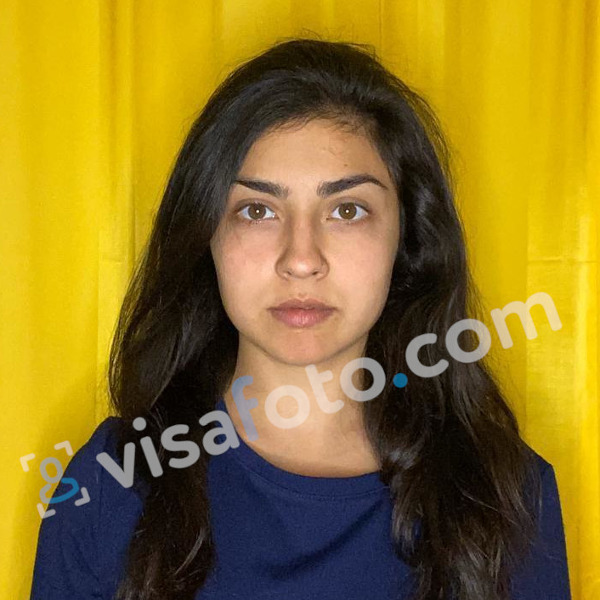
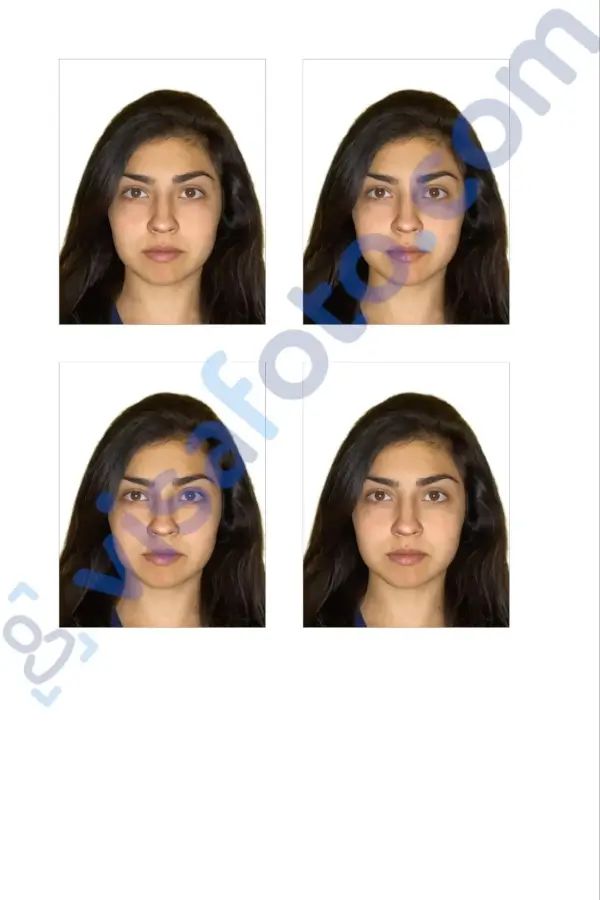
That's it! Visafoto will automatically adjust the background, size, and head position to meet official requirements. You'll receive a digital copy perfect for online submissions and a print-ready format.
Example of the photo you can upload to Visafoto:
Result from Visafoto:

With a 99.7% acceptance rate and more than 1,000,000 photos accepted by government authorities, Visafoto guarantees compliance with official requirements or provides a full refund. Our tech support is available 24/7 for any assistance.
Russian work visa validity and renewal
Russian work visas are issued for fixed periods that are linked to the terms of employment. The table below shows how long a visa remains valid for and whether it can be renewed or extended.
| Visa type | Initial validity | Key renewal/extension Inside Russia |
|---|---|---|
| Standard work visa | Single‑entry work visa, usually up to 90 days, issued by consulate on work‑visa invitation. | Can be extended and converted to a multiple-entry visa for up to 1 year, based on work permit validity. |
| HQS work visa | Often issued directly as multiple‑entry up to 3 years, matching HQS contract/permit. | Can be extended for another term without leaving Russia as long as high‑salary and reporting conditions are met. |
| 2026 Skilled Visa | A one‑year business‑type visa that already allows work while residency is processed. On approval, you receive 3‑year temporary residency or, in some cases, direct PR; both allow work. | Temporary residency can be extended or converted to PR. PR is long‑term and no longer tied to a specific work visa. |
Post-arrival formalities in Russia
After entering Russia, foreign workers must complete several mandatory registration steps. Below we cover migration registration, medical procedures, and timelines that apply once you arrive.
After arriving in Russia on a work visa, Indian nationals must register their stay with the local Ministry of Internal Affairs (MVD) office or through their employer/host within the first week at their place of residence, securing a temporary registration certificate that legalises their presence and is necessary for subsequent procedures.
Within 30 calendar days of uninterrupted stay, foreign workers must complete a mandatory medical examination and biometric enrollment — including tests for HIV, drug use, and certain infectious diseases — at authorised medical centres, with major facilities like the Sakharovo Multifunctional Migration Centre in Moscow designated for these procedures.
Once these formalities are done, workers will typically convert their initial visa status into a multi-entry work visa tied to their employment contract. You must also update your registration details if you change address, report changes in work contract terms to migration authorities, and observe renewal timelines to maintain lawful status and employment eligibility throughout your stay.
Rights, duties and working conditions
Holding a Russian work visa comes with defined legal rights and responsibilities. Below we outline how to work in Russia as a foreigner, and what their basic rights and duties are.
As a foreign worker in Russia, you share core labor rights and duties with Russian employees, with additional obligations linked to your migration status. Your employment contract will enforce the Russian Labour Code, covering work hours, leave, pay, safety, and termination rules.
Indian workers in Russia enjoy core labour rights under the Russian Labour Code, which applies equally to foreign nationals once they hold valid work permits and employment contracts. Employers must pay salaries in Russian roubles at least twice monthly, adhere to minimum wage standards, and respect terms set out in written contracts, including provisions for wages, working hours, paid leave, and occupational safety — protections that extend to Indian workers as soon as they begin employment.
Beyond wages, contracts often include insurance and repatriation clauses, and employers generally provide mandatory medical insurance, as required under the Federal Law Governing Foreign Citizens, ensuring healthcare access during employment.
Indian nationals working in Russia must work only for their sponsoring employer, remain registered for tax purposes, and comply with migration and employment laws, including maintaining valid permits and visas. Changing occupations, employers, or residence without notifying authorities can lead to administrative penalties or affect legal status.
FAQ
How long does it take to get a work visa to Russia?
Once you submit your application in India, the standard processing time for a Russian work visa is typically 10 working days at the embassy or consulate. However, the more time-consuming part often involves your Russian employer obtaining the approved work invitation, which can take several weeks before you’re eligible to apply.
Can dependents accompany on a work or skilled visa and work in Russia?
Under current Russian rules, standard work visa holders' spouses and children can sometimes come on separate private/guest or dependent‑type visas, but these generally do not give automatic work rights. A spouse would usually need their own work basis (job offer + permit) to work legally.
HQS holders can sponsor family. Dependents may live in Russia for the duration of the HQS status and can work if they obtain their own work authorisation or residence linked to the HQS holder.
Emerging 2026 Skilled Visa rules aim to change this framework: the new Skilled Visa programme — launching in April 2026 — will extend the long-term residency and work benefits to family members of eligible applicants, allowing spouses and children to live and work without separate permits alongside the principal visa holder.
Difference between standard work visa, HQS route, and 2026 Skilled Visa for Indians in terms of cost, processing, and residency prospects.
| Aspect | Standard Work Visa | HQS Route | 2026 Skilled Visa (from 15 Apr 2026) |
|---|---|---|---|
| Cost | Lower state fees and salary levels. Best for mid‑level jobs and cost‑sensitive employers. | Higher employer cost due to mandatory high salary, but you earn more if you qualify. | Focus on documentation/agency and residency processing, not a high salary floor. Designed as a “work + PR” package. |
| Processing | Employer quota + work permit (weeks) then consulate (4–20 working days). 90‑day entry, then convert in Russia. | Fast‑track permits and a 3‑year multi‑entry visa once the HQS contract is approved. | Two‑stage: online assessment → 1‑year work‑allowed visa → residency decision in about 30 days after arrival. |
| Residency | Purely temporary status. Renewals possible but no direct PR shortcut. | Recognised as a strong path towards temporary and then permanent residence after several years. | Built as a direct route to a 3‑year temporary residence or immediate PR for eligible profiles, including families. |