Getting a TIE (residency card) in Spain
The Foreigner Identification Card or Tarjeta de Identidad de Extranjero (TIE) is required for many foreign residents living in Spain for more than six months. It identifies the holder and confirms their legal status in the country. Obtaining a TIE is usually the final step after the relevant residence, work or study authorization has been granted.
Table of contents
- Rights and obligations of TIE holders
- Do UK citizens need a TIE?
- How to get a residence permit in Spain?
- Steps for obtaining a TIE
- TIE: required documents
- TIE photo requirements
- How to extend TIE?
- What to do if TIE was lost, stolen or damaged?
This article will discuss how to get a TIE and what documents you will need.
Rights and obligations of TIE holders
Most non-EU citizens who have been granted a visa or authorization to stay in Spain for more than six months must apply for a TIE. The application is generally made in person within one month of entering Spain or receiving the authorization. A TIE is generally not issued for an authorized stay of six months or less.
The TIE documents your permission to stay in Spain; it does not itself grant an unlimited stay or visa-free entry to every EU country. Carry your valid passport when travelling and check the entry rules for your destination. Whether a student may work depends on their study authorization. For eligible long-term study authorizations, work must be compatible with the studies and generally cannot exceed 30 hours per week.
A TIE can help you prove your identity and legal status when opening a bank account or accessing services in Spain. Access to any particular service depends on its own eligibility rules.
The TIE does not itself determine where you may work in Spain. If your residence and work authorization has geographic or other work conditions, you must follow those conditions.
After five years of legal residence in Spain, you may be eligible to apply for long-term residence, residencia de larga duración, if you meet its requirements. This is a separate immigration status, not an automatic result of holding a TIE for five years.
Your TIE also displays your NIE, the foreigner identification number. An NIE is an identification number, not a residence permit.
Do UK citizens need a TIE?
Most UK citizens who move to Spain need to register as residents and obtain a TIE if their stay requires residence authorization. UK citizens who were legally resident before 1 January 2021 and hold a green residence certificate have a valid document proving their rights under the Withdrawal Agreement. They are advised to exchange it for a TIE, especially for travel under the EU Entry/Exit System.
How to get a residence permit in Spain?
The process of obtaining Spanish residency or a permit to stay in Spain for studies depends on the type of authorization:
- First stage: obtain the appropriate residence or study authorization. Some applicants must apply through a Spanish consulate before travelling; other routes allow an application from within Spain. A long-stay D visa is not required in every case. Follow the entry and application deadlines for your specific route.
- Second stage: once your authorization has been granted, apply for a TIE in Spain if your category requires one. This is generally done within one month of entering Spain or receiving the authorization.
Steps for obtaining a TIE
- Make an appointment for the TIE and fingerprint procedure in your province through the official appointment service. Select the procedure that matches your case and keep the appointment confirmation.
- Pay the TIE fee using form 790, code 012. The amount depends on the card category. The current Police fee table lists €16.08 for many first cards, €19.30 for many renewals and €21.87 for long-term residence cards. The €12 fee applies to certain other categories.
- Collect the documentation package (see list below) and bring it to the office at the appointed time. You will also need to have your fingerprints taken there.
- Wait for the card to be issued. Processing and collection times vary by office. Keep any receipt or collection instructions given at the appointment, and bring the documents requested by the office when collecting your card.
TIE: required documents
The exact documents depend on whether you are applying for an initial card, a renewal or a replacement. For an initial TIE, prepare the following, subject to the instructions for your appointment:
- A valid passport or travel document and the required copies;
- One recent printed colour photo, 32 × 26 mm, against a plain white background;
- A certificate of registration at your address, if requested for your case;
- Proof of payment of form 790, code 012;
- Printout of confirmation of your appointment;
- Application Form EX-17, completed and signed, with the original and a copy;
- The decision granting your residence or study authorization, if required for your category.
Depending on your procedure and province, you may be required to submit additional documents. Check the instructions for the appointment you selected.
TIE photo requirements
To avoid problems with your TIE application, make sure that the printed photo meets the following requirements:
- Bring one recent colour photo measuring 32 × 26 mm;
- The photo must have a plain white background;
- Look directly into the camera with a neutral facial expression;
- Your facial features must be clearly visible. Make sure no hair or shadows fall on your face;
- Headwear worn for religious or medical reasons is permitted if the full outline of your face remains visible.
Here is an example of a TIE photo:
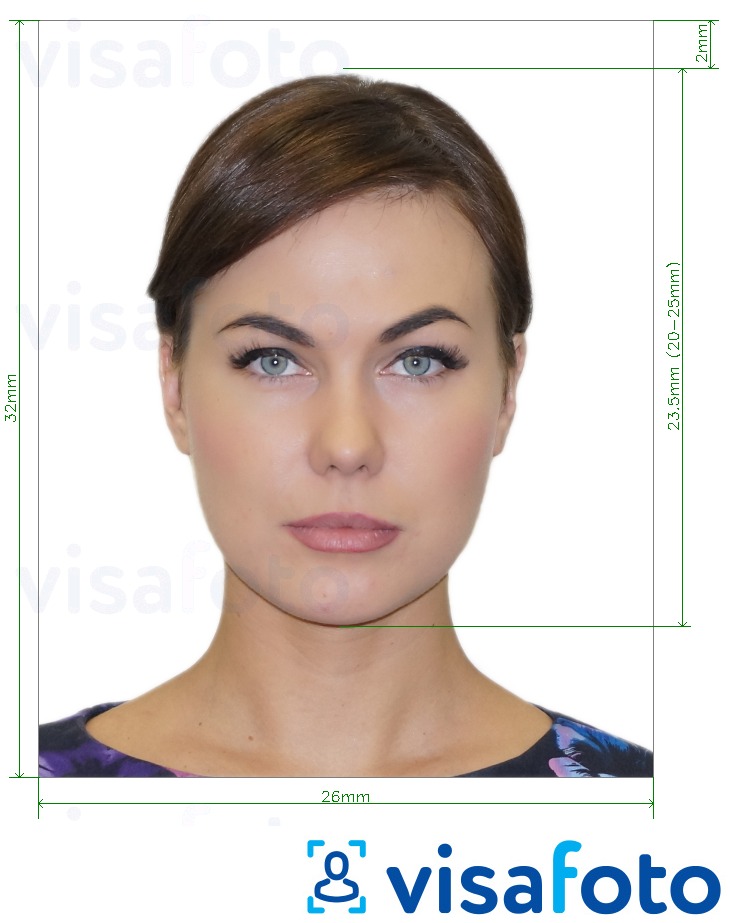
To instantly take a TIE photo online, simply upload any of your portraits taken in full-face here. Visafoto will resize the photo in millimeters and pixels, change the background to white, adjust the quality and prepare the photo for printing.
Source

Result
Visafoto guarantees that the photo you take will meet your requirements. In case of any problems, we will replace the photo free of charge, or you will get a full refund.
How to extend TIE?
The validity of a TIE depends on the type and duration of the underlying residence or stay authorization. There is no single one-year, two-year and five-year sequence that applies to every card.
If your authorization requires renewal, apply for that renewal first and then request a new TIE when it is approved. The documents for a renewed card may differ from those needed for an initial card, so check the requirements for your procedure.
See our Spanish TIE renewal guide for deadlines, documents and the new-card procedure.
What to do if TIE was lost, stolen or damaged?
A mandatory requirement for restoring the TIE is to report the theft or loss to the police. If it is a question of damage, it is necessary to show the migration authorities the card itself to verify that it is unusable.
The TIE card recovery procedure is considerably more complicated if the theft, damage or loss has occurred outside Spain. In this case, it is necessary to request a visa at the Spanish Consulate in the applicant's country of residence, which will allow you to return to Spain and begin the procedure for restoring the documents.
To obtain a new residence card, you must apply to the appropriate police department dealing with migration issues and pay the state fee.