US Passport for Minors: Do Both Parents Need to Be Present in 2026?
U.S. rules (22 C.F.R. § 51.28(a)(2)) say that both parents or legal guardians must sign the application for a child under 16.
However, the “both parents” requirement often raises questions, especially when families are separated, traveling, or living abroad. While the policy aims to prevent disputes and protect children, its details are often misunderstood.
This guide outlines when both parents must be present and what to do if they are not.
Table of contents
- Who Counts as a Minor for a US Passport?
- The General Rule: Both Parents are Involved
- Documents Required for a Minor’s Passport Application in the US
- Get a Child’s Passport Photo at Home!
- When Both Parents Must Appear in Person
- When Only One Parent Can Appear
- Instructions on Form DS-3053: Statement of Consent
- When Consent From the Other Parent is Not Needed
- What to Do if the Other Parent Refuses to Sign or Cooperate
- Rules for Minors Applying Overseas
- Teenagers Aged 16–17: Special Rules
- FAQ
Who Counts as a Minor for a US Passport?
In the context of U.S. passport regulations, a "minor" refers to anyone under the age of 18. However, the rules vary based on specific age groups.
Official definition and age categories:
- According to U.S. guidelines, a "minor" is an unmarried individual under the age of 18.
- For passport applications, the Department of State typically distinguishes minors into two key categories: those under 16 years old and teenagers aged 16 to 17.
The General Rule: Both Parents are Involved
US authorities require the consent of both parents or legal guardians to issue a passport to a child under 16. Below, we explain what this rule means.
Specifically, this involves:
Both parents or guardians must typically accompany the child to a passport acceptance facility, signing the application under oath. They must provide proof of their relationship (such as a birth certificate), a valid photo ID, and confirm their consent for the passport issuance.
How many parents need to sign a child's passport? Both parents or guardians need to sign the application, presenting proof of relationship and consent. Teens aged 16 or 17 can generally sign their own application, but at least one parent should usually be present. In some cases, written parental consent may be required.
This requirement aims to prevent international abduction and ensure that children do not leave the country without both parents' knowledge or approval.
Documents Required for a Minor’s Passport Application in the US
For minors applying for a U.S. passport, documents needed vary slightly between children under 16 and those aged 16–17, though the core requirements are similar. Here, you’ll find out about the full list of required documents.
For children under 16
When both parents are present:
- Form DS-11, completed online and printed single-sided. Wait to sign it until instructed by the acceptance agent.
- Proof of U.S. citizenship for the child: Provide one of the following:
- Original U.S. birth certificate (must meet state registration standards)
- Consular Report of Birth Abroad (FS-240)
- Certificate of Citizenship or a valid/expired U.S. passport.
- Proof of parental relationship, such as a birth certificate, adoption decree, or court custody order.
- A valid government-issued parents’ photo ID, like a passport or driver’s license, along with photocopies of the front and back.
- One child’s 2×2-inch color photo in U.S. passport format.
- Photocopies of the child's citizenship document and any prior passport (if applicable), and copies of each parent's photo ID.
- Application fee, payable by check or money order to the "U.S. Department of State."
If only one parent is present, you must also provide:
- Notarized consent (Form DS-3053) from the absent parent, or
- Court order or documents proving sole custody, or proof of the other parent's death or incapacity.
For minors aged 16–17
Requirements are similar, with slight differences:
- Form DS-11. The minor signs their own application.
- Proof of U.S. Citizenship and Photo ID for the Minor. You will need similar documents as above, along with the minor’s photo ID (if available) and a photocopy.
- Parental awareness. Show that at least one parent is aware of the application, either by their presence or a written statement.
- A 2×2-inch passport photo and the application fee.
Get a Child’s Passport Photo at Home!
You can create a passport photo for your child without visiting a studio and still meet official requirements. Here you’ll learn what you need to prepare a compliant image online.
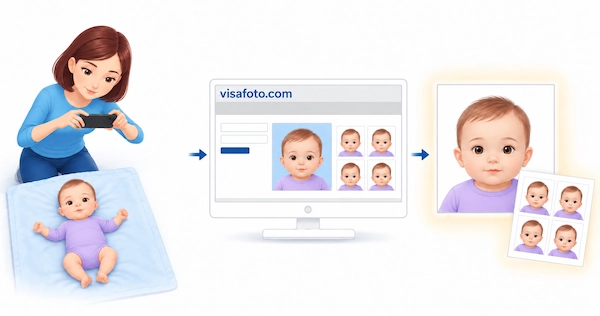
Parents can produce a correct, professional-looking photo at home using tools such as Visafoto. The service converts a regular snapshot into a U.S. passport-ready image by adjusting the background, dimensions, and head position to match official standards. All it takes is two simple steps:
- Upload a clear photo of your child taken in natural daylight to the Visafoto tool.
- Choose the country and document type (for example, United States, passport).
That’s it! The system handles the rest automatically and delivers a ready-to-use result. You can download a digital file for online submission or print a properly formatted copy.
Example of the original photo you can upload:

Edited result after processing:

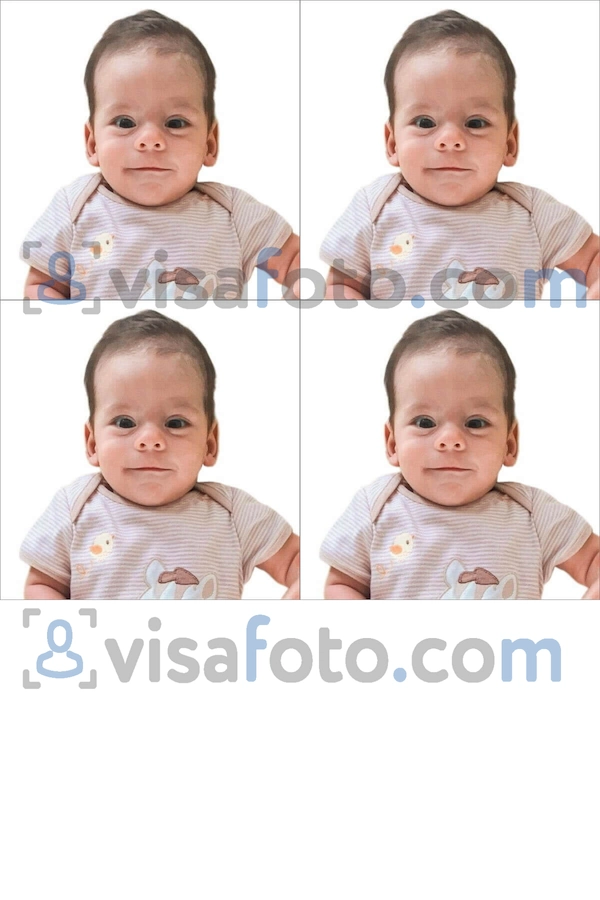
Visafoto reports a 99.7% acceptance rate, with over 1,000,000 images approved by authorities. If your photo does not meet official U.S. requirements, our service offers a full refund, and our technical support is available 24/7.
When Both Parents Must Appear in Person
Do minors need both parents to get a passport? In most cases, both parents need to be physically present when submitting a child’s passport application at an acceptance facility:
- For a child under 16, both parents or guardians need to be there in person when applying for the child's passport, unless an exception is applicable.
- This applies to first-time applications and renewals, as both parents must sign Form DS-11 in front of the acceptance agent.
When Only One Parent Can Appear
How to get a child's passport with one parent absent? The Department of State allows the passport application submitted by one parent to proceed if specific conditions are met. Below, we explain when this option applies and what the passport requirements are for a minor if a parent is abroad.
Children Under 16
Typically, both parents should sign the application, but one parent or guardian can handle the process if they provide the following:
- Notarized consent (Form DS-3053) from the absent parent, along with a copy of their photo ID.
- Proof of sole legal custody, such as a court order, a birth certificate listing only one parent, or a death certificate for the other parent.
- A Statement of Exigent/Special Family Circumstances (DS-5525) if the other parent cannot be found or cannot give consent.
Teens Aged 16–17
The process is more lenient. The minor can sign Form DS-11, but at least one parent should be aware of the application. If only one parent is there, they need to provide proof of identity and their relationship to the minor; full consent from both parents is not as strictly enforced as it is for younger children.
Instructions on Form DS-3053: Statement of Consent
Form DS-3053, known as the "Statement of Consent," is essential when one parent or legal guardian cannot accompany a minor to apply for a U.S. passport. The absent parent must complete, sign, and have this form notarized before submitting it with the DS-11 passport application. Here, you’ll find out about the correct way to fill out this form and avoid common mistakes.
Key instructions and rules:
- Who completes the form: The non-attending parent or legal guardian fills out DS-3053. The parent attending the passport appointment does not need this form.
- Language and format: Use black ink and write clearly or type the information. If you make a mistake, fill out a new form; do not cross out errors.
- Original required: Submit the original notarized DS-3053 with the child's passport application. Scans are not accepted, except in cases of emergency travel.
Filling out DS-3053:
- Section 1 – Child Information: Enter the child's full name, birth date, and place of birth exactly as on the birth certificate or previous passport.
- Section 2 – Non-Attending Parent Details: Provide your full name, address, birth date, and relationship to the child.
- Section 3 – Consent Statement: Indicate your consent for the child to receive a U.S. passport and acknowledge understanding the requirements.
- Section 4 – Signature and Notary: Sign the form in front of a notary public or passport acceptance agent. The notary will complete their section, including seal and date. Some offices may require a photocopy of the ID you presented, which should be attached to the DS-3053.
Practical tips:
- The form is valid for 90 days from notarization for passport application purposes.
- Keep a copy of the completed and notarized DS-3053 for your records. Acceptance agents may keep a copy on file as well.
When Consent From the Other Parent is Not Needed
Can a single parent get a passport for their child? In certain legal circumstances, it's possible to apply for a U.S. passport for a child without needing consent from the other parent. Here you’ll find the situations where you can proceed without the other parent's signature or Form DS-3053:
- Sole legal custody: If you have sole legal custody through a court order, adoption decree listing only you, or a declaration of the other parent's incompetence, you can apply without the other parent’s consent. Simply present the relevant custody documents.
- Single parent listed on birth certificate: If the child's birth certificate or Report of Birth Abroad names only you, you have sole authority to apply, and the other parent's consent is not necessary.
- Deceased parent: If the other parent has passed away, submit the death certificate instead of relying on consent or Form DS-3053.
- Exigent or special circumstances (DS-5525): If the other parent is unreachable, uncooperative, or poses a threat (e.g., history of abuse or kidnapping), you can fill out Form DS-5525, Statement of Exigent/Special Family Circumstances. The other parent’s consent won’t be required, although the Department might ask for further documentation or an interview.
- Third-party applications: A third party, such as a grandparent, can apply for a child under 16 if both parents or the sole custodial parent provides written, often notarized, authorization. If only one parent gives authorization, they must have sole custody, thus negating the need for the other parent's consent.
- Minors aged 16–17: For these teenagers, the requirement is more about parental awareness than full consent from both parents. If one parent is present or clearly acknowledges the application, a separate statement from the other parent is generally unnecessary, although it may occasionally be requested by the Department.
What to Do if the Other Parent Refuses to Sign or Cooperate
A refusal from one parent does not automatically end the process, but it does make it more complex. There are legal steps and alternative forms that may allow the application to proceed. Below, we explain what options are available and how to handle this situation.
Establish Sole Authority
If you possess a court order granting sole legal custody, you can apply for the passport without the other parent's signature. Be sure to include a certified copy of the custody order with your application.
The order should grant you sole legal custody or specifically authorize you to get a passport for your child and permit the child to travel with you.
Note: If the order mandates permission from both parents for major decisions, you might need further court approval before submitting the passport application.
Use Form DS-5525 (Exigent/Special Family Circumstances)
In situations where the other parent is unlocatable or uncooperative, submit Form DS-5525:
- This form allows you to explain why the other parent's consent isn't possible.
- Attach supporting documents such as restraining orders, police reports, or affidavits detailing abandonment or difficulties in contacting the other parent.
Be aware that the Department of State reviews these requests on a case-by-case basis and may limit the passport's validity even if approved.
Pursue a Court Order
If the other parent refuses cooperation without valid reasons:
- Ask a family court to compel them to sign DS-3053 or grant you the authority to obtain the passport.
- If a custody agreement requiring cooperation exists, file a motion to enforce it, which might lead to sanctions against the non-cooperative parent or modification to grant you passport authority.
In conclusion:
- Start by checking if your custody order or the child's birth documents already grant you sole authority. If they do, apply with those documents and Form DS-11.
- If the other parent won’t sign and you lack sole authority documents, consider filing DS-5525 with strong evidence of refusal or absence, or seek a court order to gain the necessary authority.
Rules for Minors Applying Overseas
When minors apply for a U.S. passport from abroad, the process is quite similar to applying within the United States, but it takes place at a U.S. embassy or consulate, typically requiring an appointment. Here’s what you need to know:
- In-person requirement for children under 16: Both the child and their parents or legal guardians must appear in person at the U.S. embassy or consulate. This strict rule helps protect against international parental child abduction.
- Use Form DS-11: Form DS-11 is mandatory for first-time passport applications, renewals, or replacements for minors.
- Do not sign the form: Complete Form DS-11 online using the embassy's "Form Filler" link. Print the form, but hold off on signing it until you are in the presence of a Consular Officer.
- Schedule an appointment: Book an appointment online through the website of the U.S. embassy in the country where you are located.
Required documents are as follows:
- Completed Form DS-11, printed single-sided and unsigned until instructed by a consular officer.
- Proof of U.S. citizenship for the child, such as a U.S. birth certificate, Consular Report of Birth Abroad, prior U.S. passport, or citizenship certificate.
- Two passport-style photos of the child (2×2 inches, meeting U.S. standards).
- Evidence of parental relationship, such as a birth certificate listing the attending parent(s).
- Valid photo ID for the parent(s), plus a photocopy.
- Payment confirmation – most consulates require online payment through the U.S. government portal. Print the e-receipt and bring it to your appointment.
Parental Consent Procedures Overseas
If one parent can’t be present, the process varies based on their location. Here is how to get a child's passport with one parent deceased or absent:
- If the absent parent is in the U.S.: They can complete Form DS-3053 before a notary public, then mail the original notarized form to you for the appointment.
- If the absent parent is in another country: They must visit a U.S. embassy or consulate to notarize Form DS-3053 before a Consular Officer. There’s no fee for this service.
- If the other parent is deceased or you hold sole legal custody: Bring the original, certified death certificate or court order granting sole custody.
For 16-17-year-olds, many embassies allow them to apply without a parent present, but it’s recommended that at least one parent attend or provide documentation showing they are aware of the application.
Teenagers Aged 16–17: Special Rules
Applicants aged 16 and 17 are treated differently from younger children, with more flexibility in the consent process. While parental involvement is still expected, the requirements are less strict. Here you’ll learn what changes at this age.
Key rules for 16–17-year-olds:
- Form DS-11, in-person only: Even if you had a passport as a child (under 16), you must apply in person using Form DS-11 for your first 10-year "adult" passport.
- Sign your own application: At 16 or 17, you sign your own Form DS-11. Unlike younger applicants, your parents aren’t required to sign.
- Passport validity: Passports issued at 16 or older last for 10 years, compared to the 5-year validity for those under 16.
Parental awareness requirement:
While those under 16 need two-parent consent, for ages 16–17, only awareness by at least one parent or legal guardian is needed. You can demonstrate this awareness as follows:
- A parent accompanies you and signs Form DS-11 to confirm awareness (not as the applicant).
- A parent provides a signed note acknowledging awareness, accompanied by a photocopy of their ID.
- The parent handles the payment, using a check or money order in their name.
Identity and ID requirements:
- If you have a government-issued photo ID (e.g., driver’s license, state ID), present it. No need for your parent to co-sign for identity verification.
- Without a personal photo ID, a parent or guardian must accompany you, sign Form DS-11 on your behalf, and provide their photo ID with a photocopy.
Note: The U.S. Department of State highly recommends parents enroll their children in the Children's Passport Issuance Alert Program (CPIAP). This service notifies parents when a passport application is filed for their child, aiding in the prevention of international parental child abduction.
FAQ
Can one parent get a US passport for a child if the other parent is out of the country?
Yes, if the parent in the U.S. or at the embassy provides the absent parent's notarized consent (Form DS-3053) and a copy of their ID. If the absent parent cannot be located or refuses to cooperate, the applying parent can submit Form DS-5525 or show evidence of sole legal custody, death, or incapacity.
Do divorced parents both need to sign for a child’s passport in 2026?
Generally, getting a passport for a minor with divorced parents follows the same federal rules. For children under 16, both divorced parents must consent, often by appearing in person or using Form DS-3053. If one parent has sole legal custody as per the divorce decree (or is the only parent listed on the birth certificate), that parent can apply on their own.
Can grandparents apply for a US passport for a grandchild?
Typically, grandparents cannot apply unless they are the child’s legal guardian. If not, they must either bring both parents (or the sole-custody parent) or have a legal guardianship order granting them the authority to apply.
What if the other parent refuses to consent to a passport?
If the other parent refuses to consent, the applying parent needs sole legal custody via a court order or must submit Form DS-5525 to explain non-consent (due to refusal, absence, or abuse). Alternatively, a court-enforced consent or passport-authority order can be sought.
Do both parents need to appear if renewing a child’s passport?
Yes, just as they do for an initial application, both parents (or guardians) typically need to appear in person or provide written consent, such as Form DS-3053, for renewing a child’s passport for those under 16.
Can a 16-year-old sign their own passport application in 2026?
Yes, at 16 or 17, a teenager must apply in person using Form DS-11 and sign the application themselves. Although parental consent is not needed, at least one parent or guardian must be aware of the application.