Canada Super Visa for Parents and Grandparents: Complete Guide

For families seeking long-term visits rather than short stays, the Super Visa is the most practical option. Designed as a Canadian visa for parents of a permanent resident, it permits multi-year stays while maintaining temporary resident status.

Read this guide to learn everything you need to know about the Canadian Super Visa for parents and grandparents. Including how to apply, which documents to prepare, and where to get a compliant visa photo.
Table of contents
- The Difference Between Super Visa and Visitor Visa for Canada
- Canada Super Visa Benefits
- Canada Super Visa Requirements
- Step-by-Step Application Process
- Canada Super Visa Documents Checklist
- Canada Super Visa Photo Requirements
- Get a Canada Visa Photo Online!
- Canada Super Visa Application Fees
- How Long Does It Take to Get Approved for a Super Visa?
- Canada Super Visa Entry Requirements
- Canada Super Visa Validity and Renewal
- FAQ
The Difference Between Super Visa and Visitor Visa for Canada
The Canada Super Visa and Visitor Visa both allow temporary stays but differ significantly in purpose, duration, eligibility, and requirements. Here, we explain the main distinctions between the two.
A Canada Super Visa is a special long‑stay visa only for parents and grandparents of Canadian citizens or permanent residents, while a regular visitor visa is for short‑term visits by almost any eligible foreign national. The key differences are shown in the table below.
| Aspect | Super Visa | Visitor Visa |
|---|---|---|
| Eligibility | Parents/grandparents (only) of Canadian citizens/PRs/registered Indians. Cannot be used by spouses, children, or other relatives. | Most foreign nationals, for general tourism, business visits, or short family visits. |
| Max Stay per Entry | Up to 5 years (post-2023 applications) | Up to 6 months |
| Visa Validity | Up to 10 years (multiple entries) | Typically 6 months to multiple years (multiple or single entry) |
| Host Income Proof | Required (child/grandchild meets LICO-based MNI) | Not required |
| Medical Insurance | Mandatory (typically at least CAD 100,000 coverage for at least one year from a Canadian/approved provider) | Not required |
| Medical Exam | Always required | Only if you stay more than 6 months or under specific conditions |
| Primary Purpose | Extended family reunification | General tourism, business, and short visits |
| Application Fees | approx. 100 CAD for processing + 85 CAD for biometrics | about 100 CAD for processing + 85 CAD for biometrics |
So, which visa is better for parents in Canada? For brief visits, such as tourism, short family trips, or business meetings, a regular Visitor Visa is ideal if the stay is limited to up to 6 months and is not for parents or grandparents. On the other hand, if Canadian citizens or permanent residents wish to have their parents or grandparents stay longer (potentially for years), the Super Visa is preferable, provided they can fulfill the more stringent income and insurance requirements.
Canada Super Visa Benefits
The Super Visa offers extended stay privileges that are not available under regular visitor visas. Here you’ll learn how it supports long-term family reunification, multiple entries, and flexibility for parents and grandparents.
Prolonged family visits
With a Super Visa, parents and grandparents can reside in Canada with their children or grandchildren for up to 5 years per visit. This extended duration surpasses the 6-month limit of regular visitor visas, facilitating support for childcare, medical recovery, or family events without frequent departures and returns.
Long-term, multiple-entry capability
The Super Visa allows multiple entries over a 10-year period, often matching the validity of the passport. This setup enables parents and grandparents to visit Canada as needed, aligning trips with family milestones, emergencies, or seasonal preferences, without reapplying for new visas.
Reduced administrative hassle
Each stay under the Super Visa can last several years, minimizing the need for six-month extensions and decreasing paperwork. For families dependent on grandparents for continuous support or caregiving, this stability is invaluable.
Alternative to permanent residency sponsorship
The Super Visa serves as a viable option for families not yet ready or eligible for parent/grandparent permanent residency sponsorship. It demands less financial commitment while still offering significant time together in Canada.
Comprehensive health coverage
Applicants must secure private medical insurance from a Canadian provider, typically covering at least one year with a minimum of CAD 100,000. This requirement ensures access to healthcare without straining public resources, offering peace of mind for families and authorities that medical needs will be addressed during extended stays.
Canada Super Visa Requirements
Approval depends on meeting specific financial, medical, and relationship criteria. Below, we outline who qualifies and which conditions applicants must meet before applying.
Eligibility criteria for the Canada Super Visa for parents:
Applicants must be parents or grandparents of a Canadian citizen, permanent resident, or registered Indian. Applications must be submitted and approved while the applicant is outside Canada. Dependents, such as a spouse’s other children, cannot be included in the same application; each eligible parent or grandparent must apply separately.
Host requirements in Canada:
The host must be at least 18 years old, residing in Canada, and either a Canadian citizen, permanent resident, or registered Indian, as proven by documentation like a PR card or citizenship papers.
The host is responsible for meeting Canada’s Super Visa income requirements, not the applicant. They must meet or exceed the Minimum Necessary Income (MNI), which is LICO plus 30% based on family size (2025/2026 figures are effective from July 2025):
- 1 person: 30,526 CAD;
- 2 persons: 38,002 CAD;
- 3 persons: 46,720 CAD;
- 4 persons: 56,724 CAD;
- 5 persons: 64,336 CAD;
- 6 persons: 72,560 CAD;
- 7 persons: 80,784 CAD plus 8,224 CAD for each additional person.
Proof of income can include the Notice of Assessment, T4 slips for the last three tax years, pay stubs, or an employment letter. A spouse can co-sign to combine incomes.
Canada Super Visa health insurance requirements:
When choosing the best Super Visa insurance in Canada, applicants should confirm that the policy is issued by a Canadian insurer or a foreign company authorized by the Office of the Superintendent of Financial Institutions (OSFI) and covers healthcare, hospitalization, and repatriation. It must be valid for at least one year from the date of entry, paid in full, not a quote, with a minimum coverage of CAD 100,000.
Canada Super Visa medical exam:
An immigration medical exam is mandatory, conducted by a panel physician, to ensure the applicant poses no health risk and is admissible.
Additional Canada Super Visa conditions to meet:
Applicants must have a valid passport, be admissible (with no serious criminal, security, or medical issues), and provide biometrics if required. They must demonstrate strong temporary intent, showing ties to their home country, purpose of visit, financial stability, and an intention to leave Canada at the end of their authorized stay.
Can Canadian permanent residents sponsor parents? Yes, Canadian permanent residents are eligible for the Parents and Grandparents Program (PGP). Sponsors must be at least 18, live in Canada, meet the MNI for the past three years, and sign a 20-year financial undertaking (10 years in Quebec).
Step-by-Step Application Process
Applying for a 10-year Canadian visa for parents follows a structured process through IRCC. Here we walk you through each stage, from gathering documentation to the final submission.
- Collect all necessary documents from your host in Canada.
- Arrange insurance and medical examination:
- Purchase private medical insurance from a Canadian or approved provider. Ensure it offers at least CAD 100,000 coverage and is valid for a minimum of one year from your planned entry date. Obtain proof of payment.
- Schedule and complete the immigration medical exam with a recognized panel physician, and keep the information sheet or receipt for your application.
- Sign up or log in to the IRCC online portal, ensuring your personal details exactly match your passport.
- Initiate a new application to visit Canada, choosing the Super Visa option. Answer the eligibility questions to tailor your document checklist.
- Complete all required forms and upload the necessary supporting documents as per the generated checklist.
- Pay the application processing fee, and if applicable, the biometrics fee through the online system. Keep a copy of the receipt for your records.
- Once the application is complete, submit it and visit a Visa Application Centre (VAC) to provide biometrics if instructed. Continuously check your IRCC account for any additional document requests.
- Monitor your account for updates on your application's status until a decision is made and your visa is issued.
Canada Super Visa Documents Checklist
Strong documentation is essential for a successful application. Here you’ll find a concise checklist of the financial proofs, invitation letters, and additional records you need to prepare.
- Applicant's personal documents:
- A valid passport, including all bio pages and any pages with visas or stamps.
- Digital photos that comply with IRCC photo specifications.
- Completed application forms, including family information and travel history.
- Police clearance certificates, if requested, for background and admissibility checks.
- Proof of relationship and family status:
- Evidence of your relationship to your child or grandchild in Canada, such as a birth certificate listing parents' names or other civil documents confirming the relationship.
- If travelling with a spouse, include a marriage certificate or proof of common-law partnership and any requested civil status documents.
- Host in Canada – status and income proof:
- Copy of the host’s Canadian citizenship document, Permanent Resident card, Confirmation of Permanent Residence (COPR), or status card (Registered Indian), verifying they live in Canada.
- Proof that the host meets the minimum necessary income, such as a recent Notice of Assessment (NOA), T4/T1 slips, an employment letter with salary details, pay stubs, bank statements, and other savings or investment documents if required.
- Invitation letter and purpose of visit:
- A signed invitation letter from your child or grandchild, confirming financial support for your entire visit. The letter should detail household members and explain the purpose, duration, and accommodation arrangements for your stay.
- A brief personal statement from you outlining the purpose of your visit, your ties to your home country, and your intention to leave Canada at the end of your authorized stay.
- Insurance, medical, and financial evidence:
- Proof of paid medical insurance from a Canadian or approved insurer, valid for at least one year from your entry into Canada. The insurance must provide a minimum of CAD 100,000 emergency coverage, including health care, hospitalization, and repatriation. Quotes are not acceptable.
- Confirmation of your immigration medical exam from a panel physician.
- Financial documents demonstrating your financial stability, such as bank statements, pension proof, and investment records, if requested.
Canada Super Visa Photo Requirements
For a Canada Super Visa, the photo has to meet the general Canada temporary resident (visa) photo standards, since the Super Visa is a type of visitor/temporary resident visa. Here we explain the exact size, quality, and formatting rules your visa photos must follow.
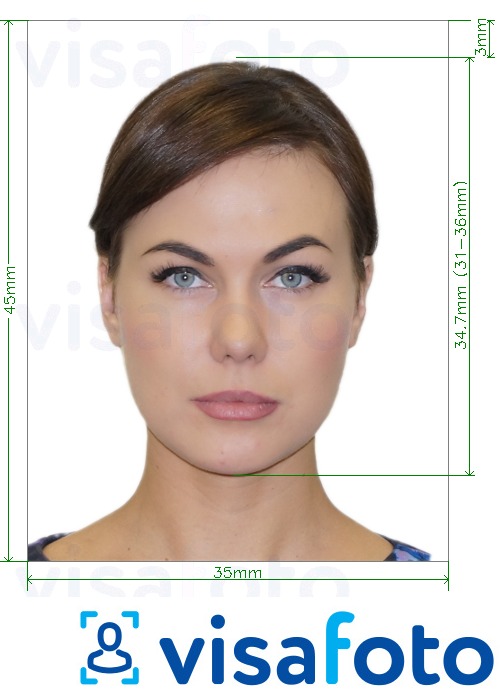
- The photo size must be 35 × 45 mm. Your head should be fully visible, centered, and include the top of your shoulders.
- The distance from your chin to the crown of your head should measure between 31 mm and 36 mm, constituting about 70% to 80% of the photo's height.
- For online applications, the photo should be a minimum of 420 × 540 pixels, in JPG/JPEG format, with size limitations as dictated by the portal.
- The photo must be clear, sharp, and in focus, taken within the last six months.
- Use a plain white or light-colored background, ensuring there are no shadows.
- Face the camera directly, with your eyes open and a neutral expression (no smiling, mouth closed).
- Head coverings are not allowed unless for religious reasons. When worn, your facial features from chin to forehead and both sides of the face must be visible.
Here is a photo example:
Get a Canada Visa Photo Online!
Here you’ll find out how to take a professional-quality passport-sized photo at home in minutes.
Using today's online photo services, you can capture a high-quality visa photo at home. Here's how to create a compliant photo in a few easy steps with Visafoto, a trusted photo editing service:
- Upload a photo taken under daylight to the Visafoto tool below.
- Select the country and document type (e.g., Canada, visa).
Visafoto takes care of the rest, automatically adjusting the background, size, and head position to comply with official IRCC photo requirements. You'll receive a digital version optimized for online submissions and a print-ready format.
Example of the photo you can upload to Visafoto:
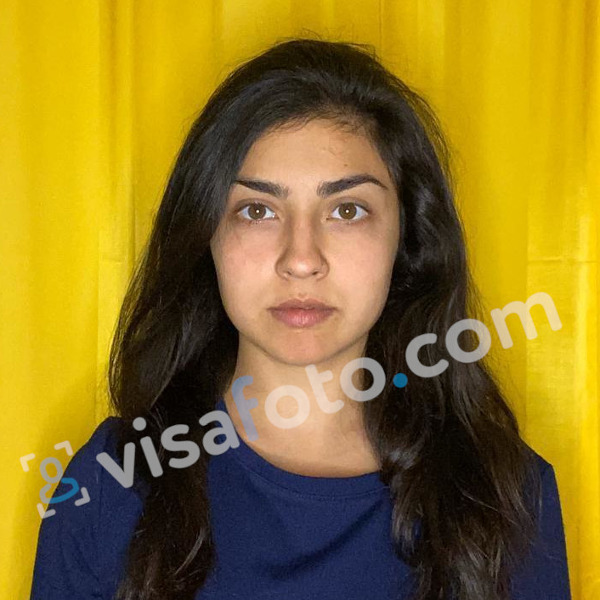
Visafoto provides a digital file for online applications as well as a version ready for printing (35×45 mm).
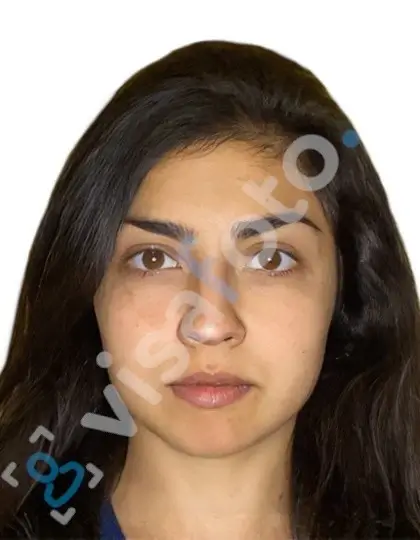
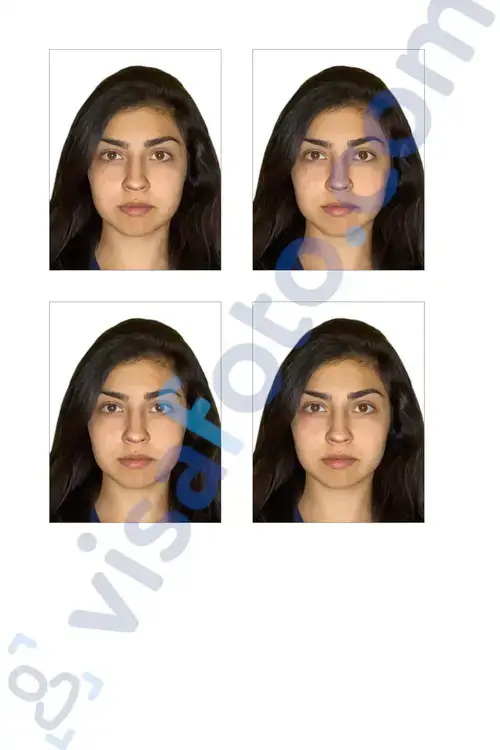
With a 99.7% acceptance rate and more than 1,000,000 photos accepted by government authorities, Visafoto guarantees compliance with official criteria or offers a full refund. If you encounter any issues, our technical support is available 24/7 to assist you.
Canada Super Visa Application Fees
For a Canada Super Visa, you pay the standard visitor‑type visa fees plus biometrics (if required). Here is the cost breakdown:
- Processing fee: The Super Visa incurs the same processing fee as a regular visitor visa, which is approximately 100 CAD per applicant. This applies to both single- and multiple-entry visas under the visitor/super visa category.
- Biometrics fee: Most applicants will also need to pay a biometrics fee of 85 CAD per person. If applying with family members at the same time and location, the maximum fee is 170 CAD for the group.
These government fees do not include any additional charges from a Visa Application Centre (VAC) for services like passport handling, SMS updates, or courier services, as these vary by country.
How Long Does It Take to Get Approved for a Super Visa?
Canada Super Visa processing times vary based on the applicant's country, visa office, completeness of the application, and whether biometrics or additional documents are needed. Here you’ll learn how long applicants typically wait for a decision.
The Canada Super Visa processing time after biometrics is usually 2 to 4 months for 80% of applications. This depends on the visa office processing your application. For instance, applications from India might take 12–16 weeks, whereas those from Europe or the United States often take 8–12 weeks.
To get the most accurate and up-to-date information, always refer to the IRCC processing times tool for your specific visa office.
Canada Super Visa Entry Requirements
Holding a Super Visa does not guarantee entry at the border. Upon arrival, parents and grandparents must present essential documents to border officers, who will evaluate their admissibility and the validity of their visa. Below are the details.
Documents required at entry:
- A valid Super Visa sticker affixed to your passport, along with your current passport or travel document.
- The original proof of paid private medical insurance, with a policy showing coverage of at least CAD 100,000, valid for a minimum of one year from your entry date, and issued by a Canadian or approved insurer.
Additional documents officers may request are as follows:
- Copies or originals of your application materials, such as the invitation letter from your host, proof of your relationship (e.g., birth certificates), and evidence of your host’s income (e.g., NOA, T4).
- Confirmation of your immigration medical exam, especially if it wasn't previously submitted or has expired.
At the port of entry, a Canada Border Services Agency (CBSA) officer will review your documents, take your photo or fingerprints if necessary, and confirm you meet the conditions for temporary residency (e.g., intent to leave Canada after your authorized stay). The officer will determine the length of your authorized stay, which can be up to five years initially, based on your insurance and other circumstances.
Canada Super Visa Validity and Renewal
A Super Visa allows extended stays over a long validity period. Here you’ll learn about its validity, duration of stays, and renewal procedures.
Super Visas are typically valid for up to 10 years from the date of issuance, or until your passport expires, whichever occurs first. They allow multiple entries into Canada during this time.
For visas issued or applied for on or after June 22, 2023, holders can stay in Canada for up to five consecutive years per visit without needing to renew their status while in the country. For older visas, issued under pre-2023 rules, the initial stay may be capped at two years, though reentry and extensions are possible.
Although you cannot renew a Super Visa itself, you can apply for a new one before the current one expires. This involves repeating the entire application process, which includes proving eligibility, obtaining insurance, undergoing a medical exam, and providing proof of your host's income.
Best of luck with your Canada Super Visa application!
FAQ
How much bank balance is required for a Canada Super Visa?
There’s no fixed bank balance required for the Super Visa applicant. However, the sponsor in Canada (your child or grandchild) must meet the Minimum Necessary Income (MNI) requirements, which are based on LICO plus 30%. This is verified through tax documents like the Notice of Assessment (NOA) and T4s over the last three years.
Can you work in Canada with a Super Visa?
No, the Super Visa does not permit work. This is strictly a visitor visa allowing extended family visits. To work in Canada, you'd need to apply for a separate work permit, such as one obtained via the Labour Market Impact Assessment (LMIA) process or a spousal open work permit if eligible.
Can Super Visa holders study short-term courses?
You are allowed to take short-term courses lasting six months or less without needing a study permit, following standard visitor rules. Longer academic programs would require applying for a study permit separately.
Is the Super Visa renewable or extendable?
The Super Visa itself cannot be renewed. You’ll need to apply for a new one from outside Canada before your current visa expires. This involves going through the full application process again. However, the authorized stay of up to five years in Canada can be extended by applying for a visitor record online before your stay ends.
Can you apply for permanent residence later?
Yes, you can apply for permanent residence later through programs like the Parent and Grandparent Program (PGP) if you receive an invitation and your child or grandchild sponsors you. This requires meeting specific income, eligibility, and intake criteria. Note that while the Super Visa doesn't by itself lead to permanent residency, your time in Canada on this visa can help demonstrate established ties to the country.