Expatriate Services Division (ESD) Application and Photo Requirements for Expats in Malaysia

Malaysia remains a prime destination for skilled expats due to its robust economy and strategic location in Southeast Asia. The Expatriate Services Division (ESD) streamlines the hiring process for foreign talent, helping businesses to fill specialized roles quickly, while ensuring they're following Malaysian immigration rules.
This guide provides all the information you need about the ESD, including the eligibility criteria and application process. We will also provide tips on how to obtain an ESD-compliant photo in a matter of seconds.
Table of contents
- Overview of ESD and Employment Pass (EP)
- Eligibility criteria for company registration with ESD
- Employer registration with ESD
- ESD application process for expatriates
- Photo requirements for ESD expatriate applications (Employment Pass or similar)
- Get a digital photo for an ESD application online!
- ESD application processing time
- Post-approval steps
Overview of ESD and Employment Pass (EP)
What is the ESD? The Expatriate Services Division (ESD) is a specialized branch of Malaysia's Immigration Department, set up in June 2014 to simplify and improve the process of hiring expatriates for businesses in Malaysia. Acting as a centralized hub, the ESD enables registered companies to manage expatriate-related immigration applications online. The hiring company applies on behalf of its employee; expatriates cannot submit their own Employment Pass applications.
The ESD offers various services:
- Employment Pass
- Residence Pass-Talent
- Professional Visit Pass
- Dependant Pass
- Long-Term Social Visit Pass
- Social Visit (Temporary Employment) — Foreign Maid Pass.
What is the EP? The Employment Pass (EP) is a Malaysian work permit for foreign nationals seeking employment in the country. It grants them permission to work for a specific employer in a designated job role. The application route depends on the employer's sector, as explained below.
There are three primary categories of the EP in Malaysia. The following basic monthly salary thresholds apply to new and renewal applications submitted on or after 1 June 2026:
| EP category | Basic monthly salary | Maximum employment duration under the revised policy |
|---|---|---|
| Category I | RM 20,000 and above | Up to 10 years |
| Category II | RM 10,000 to RM 19,999 | Up to 10 years |
| Category III | RM 5,000 to RM 9,999 | Up to 5 years |
The salary assessment excludes allowances, incentives, bonuses and salary paid outside Malaysia. For manufacturing and manufacturing-related services under MITI/MIDA, Category III has a higher minimum of RM 7,000, giving a range of RM 7,000 to RM 9,999.
The maximum employment duration is not the validity of a single pass. An individual EP can be approved for between one and 60 months, depending on the employment contract and the authorities' decision. The revised duration framework is tied to the employer, position and EP category.
Existing passes remain valid until their expiry dates. New applications and renewals submitted from 1 June 2026 are assessed under the revised policy. Mandatory succession-plan submission for Categories II and III starts on 1 January 2027. The plan sets out how Malaysian employees will be prepared to take over the role.
Category III applications submitted from 1 June 2026 are eligible to apply for dependant passes, unlike the earlier Category III rules. Family members need the appropriate pass: a Dependant Pass generally covers the spouse and children under 18, while a Long-Term Social Visit Pass covers eligible parents, parents-in-law, children aged 18 to 25 and common-law spouses. These are separate applications, not automatic permission to accompany the employee.
See the official revised Employment Pass salary-policy booklet for the policy and application flow.
Eligibility criteria for company registration with ESD
To register with the ESD and hire expatriates in Malaysia, companies need to meet certain legal registration criteria and have a minimum paid-up capital. The requirements are outlined below:
Legal registration status
Companies must be registered with one of the following entities:
- The Companies Commission of Malaysia (SSM) under the Companies Act 2016
- The Registry of Societies Malaysia (ROS) under the Societies Act 1966
- Other relevant Malaysian bodies for associations or cooperatives
Minimum paid-up capital requirements
The necessary paid-up capital is determined by the company's ownership and business sector:
- Fully locally owned: RM 250,000.
- Joint venture (at least 30% foreign equity): RM 350,000.
- Fully foreign owned: RM 500,000.
- Foreign-owned with 51% or more foreign equity in Wholesale, Retail and Trade: RM 1,000,000. Additionally, a valid Wholesale, Retail and Trade (WRT) approval is required where applicable. Foreign-owned companies in the relevant unregulated service subsectors are also subject to the RM 1,000,000 requirement and any applicable sector approval.
The guidebook exempts public limited companies, companies limited by guarantee, and associations or organizations incorporated under specific acts from these paid-up capital requirements. Registration documents still depend on the type of organization.
Required documents
Before the Malaysia ESD registration, companies need to gather and submit several documents. Here is the ESD company-registration checklist:
- Copies of all current directors' MyKad or passports
- Company profile, including its business activities, organizational structure, branch locations, photos of the premises (front and interior), and photos of its products or services
- Recent phone bill
- Tenancy or Sales & Purchase Agreement for the business location
- Latest SSM company information and the relevant registration, share-capital and director documents; the checklist refers to legacy Forms 9, 24 and 49, their listed alternatives, or related documents, with SSM-certified true copies where required
- Most recent audited financial report
- Local authorities license, if applicable
- Other necessary business licenses (e.g., WRT, CIDB)
- Any additional documents requested by the ESD during the registration process
Accounting firms, law firms, societies and other organizations may need additional registration documents. The company-registration checklist is separate from the employee's Employment Pass checklist.
Employer registration with ESD
For the ESD Online route, a company must first register and activate its employer account before submitting Employment Pass or other expatriate-related applications. This is the company's responsibility, not an account the employee opens for a personal application.
Here is how to register:
- Set up an account on the ESD portal at
esd.imi.gov.my/portal/and fill in the necessary company details. - Upload all the required documents, which are listed above in the article.
- Submit the application for review and verification by ESD officers.
- Once approved, complete company activation: nominate the authorized personnel, print the Letter of Undertaking (LoU) on company letterhead, have the designated director sign it, and upload the signed LoU and director's identification as instructed.
- After activation, the company can proceed with applications for expatriate positions and permits, subject to the relevant preliminary approvals.
Sector-specific route: eligible manufacturing companies and selected-services companies under MIDA use the MIDA Expatriate System (MES), accessed through InvestMalaysia at investmalaysia.mida.gov.my. MIDA's workflow covers company registration in the Immigration system, expatriate-post approval, pass approval and ePASS issuance. It should not be confused with the standard ESD Online submission route. The eligible sectors and registration process are explained in the official MIDA Expatriate System FAQ.
ESD application process for expatriates
Here's a step-by-step guide to the ESD application process for hiring expatriates. These steps describe the ESD Online route; employers using MES follow MIDA's process.
- Company registration and activation: after ESD registration approval, the company signs and submits a Letter of Undertaking (LoU) and gains access to the ESD portal for expatriate applications.
- Approval of expatriate positions and preliminary requirements: complete the applicable expatriate projection and position setup. Obtain approval under Section 60K of the Employment Act 1955 from the Department of Labour Peninsular Malaysia (JTKSM), and complete MYFutureJobs job advertising where applicable. Regulated sectors also need the relevant approving-agency or regulatory-body supporting letter through Xpats Gateway. A supporting letter does not replace Immigration's pass approval.
- Application submission via ESD portal:
- Log in to the ESD portal using the company's approved account.
- Prepare all necessary documents for the expatriate and any dependants (if applicable).
- Enter the details for expatriates and dependants, select the role from the "Position Setup" list, and upload all required documents.
- Pay the applicable processing fee and submit the fully completed application via the portal.
- Processing and evaluation: the MYXpats Centre reviews the application for compliance and suitability.
- Notification and approval: companies receive status updates (approved or rejected) through the ESD system. If approved, the approval letter can be printed from the system, and any applicable immigration fees will be communicated.
- Visa with Reference (VDR), where required: applicants outside Malaysia must complete the entry-visa procedure applicable to their nationality and approval. The EP approval, VDR authorization and entry visa are different documents; do not assume that the EP approval letter alone is enough to travel. Follow the approved visa procedure, including the official eVISA route where applicable.
- Pass endorsement: the company initiates endorsement, uploads the required documents and pays the endorsement fees. Most covered applications receive an electronic pass (ePASS), rather than a passport sticker. The expatriate may start the approved employment only after the Employment Pass has been issued and endorsed.
Employee documents
For an Employment Pass application, prepare:
- A clear color copy of the full passport booklet, including covers and all pages. The ESD guidebook requires at least six empty pages and passport validity of more than 12 months at submission.
- A passport-style photo that meets the requirements below.
- The highest educational qualification and any applicable professional certificate, with translation and certification where required.
- A current CV with employment history and relevant experience.
- The employment contract and applicable employer application letter.
- Relevant approving-agency or regulatory-body documentation.
- Marriage, birth or other relationship documents for dependant applications, with translation and certification where required.
- Any additional documents requested for the category or individual case.
Enter passport information exactly as required by the system, including the name shown in the machine-readable zone. Company registration documents do not replace these employee documents.
Application processing fees
The MYXpats fee schedule effective from 1 September 2024 lists the following processing charges for new applications and renewals:
| Application | Processing fee, excluding 8% SST | Processing fee including 8% SST |
|---|---|---|
| Employment Pass (EP) | RM 2,000 | RM 2,160 |
| Dependant Pass (DP) | RM 500 | RM 540 |
| Long-Term Social Visit Pass (LTSVP under EP) | RM 500 | RM 540 |
| Professional Visit Pass (PVP) | RM 1,200 | RM 1,296 |
These are not the total cost of the pass. Separate Immigration endorsement and visa fees may apply. Public universities and government/ministry applications are exempt from the MYXpats processing charges; certain invited or visiting lecturer and professor positions are also exempt from the PVP processing fee. MIDA's June 2026 FAQ lists equivalent base evaluation fees for its route, also excluding 8% SST and Immigration fees.
Photo requirements for ESD expatriate applications (Employment Pass or similar)
For your work pass application photo, use the specifications for the application you are submitting. ESD's dedicated photo page gives the following requirements:
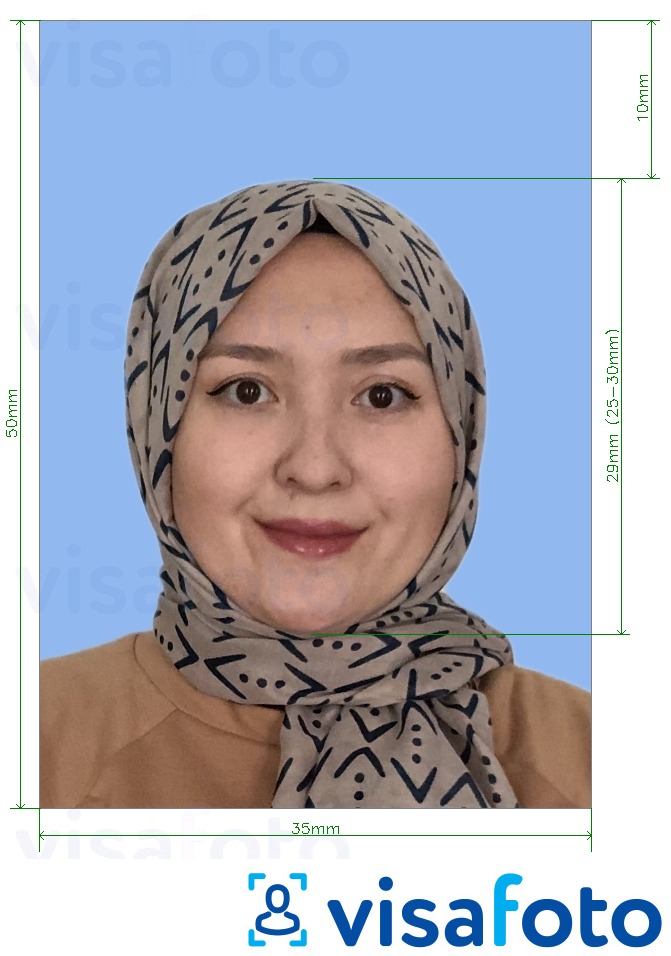
- Photo size: 35 mm wide × 50 mm high
- File size for ESD Online: Maximum 25 KB
- Head height: 30 to 35 mm, measured from chin to crown
- Space above the head: Approximately 5 mm
- Space below the chin: 5 to 10 mm
- VTR application background: Plain white
- VDR application background: Plain white or plain blue
- Border or frame: Not allowed
VTR means Visa Without Reference, while VDR means Visa With Reference.
- You should face the camera directly with your eyes open and a neutral expression.
- The picture should capture you from the shoulders to the top of your head, with the head size and margins specified above.
- The finished background should be plain, without distracting items or shadows.
- Headgear is not allowed unless worn for religious purposes, like a hijab, but it must not cover your face.
- Glasses must not obscure your eyes or prevent clear identification.
- The photo must be of high quality, ensuring clear recognition: well-lit, sharp, and not blurry or tilted.
he 2025 ESD Online guidebook specifies 99 × 142 pixels and a light-blue background in its Employment Pass checklist. MIDA's June 2026 dependant checklist also uses those dimensions and background.
The official ESD photo requirements page also links to Malaysia's eVISA photo checker at malaysiavisa.imi.gov.my/evisa/check-photo. ESD advises downloading the uploaded photo and checking it before submitting the application. This check does not replace the authorities' final review.
Here are examples of the 35 × 50 mm Employment Pass format and the 99 × 142-pixel format referenced in the application checklists. Use the format requested for your application:

Get a digital photo for an ESD application online!
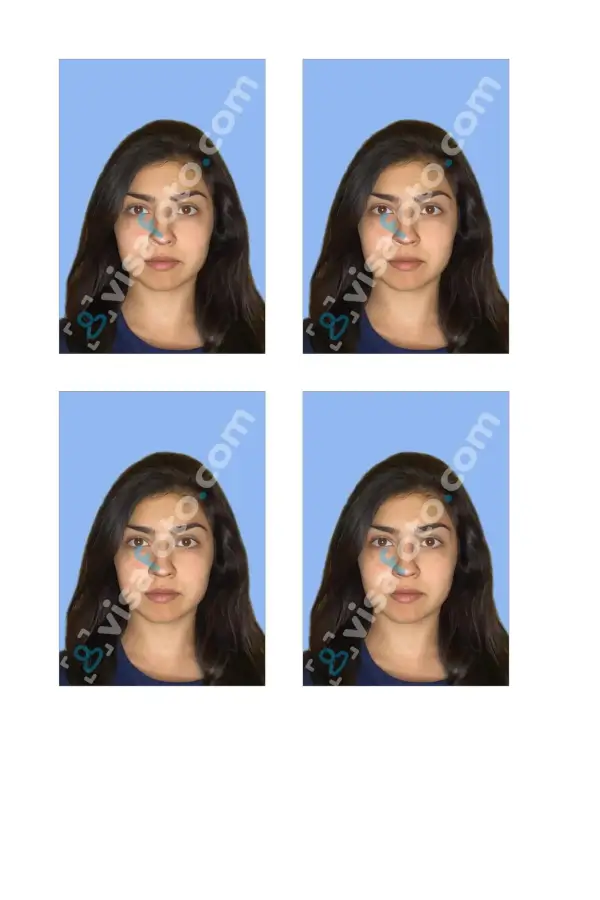
To easily ensure your photo meets the Malaysian employment pass requirements, try using online professional tools like Visafoto.com. Our tool quickly converts your image to meet all official criteria. Since 2013, Visafoto has been adapting photos for passports, visas, licenses, and many other documents worldwide.
Here's how to begin: Simply take a photo in natural light and upload it to our tool below. We’ll take care of the format, background, and size adjustments for you.
Upload a photo like this:

You'll receive both a digital version for online applications and a print-ready format. If you're not happy with the outcome, we offer a free photo replacement. In case your photo is not accepted by authorities, we provide a full refund.

ESD application processing time
The standard MYXpats processing target for a complete expatriate pass application is five working days. Tier 1, Tier 2 and Critical Sector companies qualify for a three-working-day processing target. Once endorsement payment has been made, ePASS processing takes one working day.
These are separate stages. They do not include all the time needed for company registration and activation, labour approvals, job advertising or agency supporting letters. An incomplete application or a request for additional documents can extend the overall process. For employers using MES, MIDA's June 2026 FAQ gives a separate 15-working-day processing target for complete applications: ten working days at MIDA and five at its Immigration Unit.
If your application is rejected, an authorized company representative must initiate and submit an appeal within 14 days of the Expatriate Committee's rejection date. A complete appeal may take up to 30 working days to review. There is no additional appeal fee, but the application processing fee becomes non-refundable once an appeal is initiated.
For a rejected application without an appeal, MYXpats provides a 75% refund of the expatriate processing fee, subject to its terms. A refund request must be made within six months. This is not a refund of every Immigration or visa fee paid.
To check your work pass application status, follow these steps:
- Open the ESD application status page at
esd.imi.gov.my/portal/application-status/. - Enter the expatriate applicant's passport number, the company registration number and the captcha code shown on the page.
- Click "Check Status". The system will show the current status of your application.
The company should also monitor its ESD Online account and notification emails. Applications submitted through MES are tracked through the employer's InvestMalaysia account.
Post-approval steps
After receiving approval for an expatriate application through the ESD portal, the following actions are necessary to complete the process and enable the expatriate to start working in Malaysia:
- Download and print the approval letter from the ESD portal, as it's required for subsequent steps.
- If the expatriate is abroad, complete any required VDR and entry-visa procedures before travelling.
- Have the company initiate the endorsement request in ESD Online, upload the required documents and pay the applicable Immigration fees.
- Complete the appropriate ePASS endorsement route:
- ESC at KLIA Terminal 1 or 2: the employer arranges the endorsement request and payment before arrival. The applicant proceeds to the Expatriate Satellite Centre after arrival for ePASS endorsement and i-KAD issuance where applicable. No appointment is required for this route.
- MYXpats online endorsement route: after the applicant has entered Malaysia through an air or land checkpoint, the employer submits the endorsement request and pays. The ePASS becomes available through the company's ESD Online account. The i-KAD, where applicable, is delivered to the selected company address; it is issued to Employment Pass holders, not every dependant or PVP holder.
- Download the issued ePASS, check its details, and keep a printed or digital copy readily available with the passport registered on it. There is no requirement to paste the ePASS inside the passport.
Public universities and government agencies continue to use the manual endorsement process at Immigration headquarters or state offices until further notice. Employers using MES follow MIDA's endorsement arrangements instead of assuming the MYXpats options above apply.
For an EP applicant entering from outside Malaysia, the ESD guidebook gives 30 days from arrival to complete endorsement. For an applicant already in Malaysia, it gives 30 days after approval. An approval letter alone is not permission to start work: the Employment Pass must first be issued and endorsed.
If you receive a new passport, the employer must complete Transfer of Endorsement (TOE) / Take-Up Balance (TUB) so that the ePASS reflects the new passport. Do not travel relying on an ePASS that has not been updated for your replacement passport.
Last updated: 14 October 2026.