Thailand work visa (Non-B). Requirements, application and work permit

Foreign nationals who plan to work in Thailand generally need two key documents: a Non-Immigrant B visa and a work permit. The visa allows entry and stay for employment purposes, while the work permit authorizes the holder to work legally.
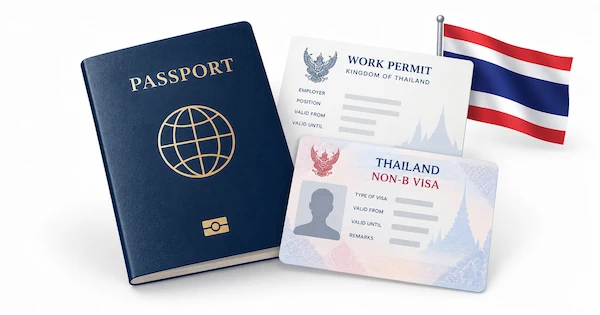
This guide explains how to get a working visa in Thailand, including requirements, application process, documents, and work permit rules.
Table of contents:
- Thailand work visa (Non-B) explained
- Who needs a Non-B visa to work in Thailand?
- Non-B visa vs. Thailand work permit: what is the difference?
- Thailand work visa eligibility and requirements
- Thailand Non-B visa application process
- Thailand Non-B visa documents checklist
- Get your Thailand visa photo online!
- How to apply for a work permit after entering Thailand on a Non-B visa
- How long does it take to get a Non-B visa to Thailand?
- Thailand work visa cost and fees
- Bringing your family to Thailand on a Non-B visa
- Non-B visa and work permit duration of stay and extension rules
- Re-entry permits and traveling outside Thailand
- FAQ
Thailand work visa (Non-B) explained
The Non-Immigrant B visa is the main visa category for foreigners who plan to work, conduct business, or attend business meetings in Thailand. For employment, it normally provides the immigration status needed to proceed with the Work Permit application.
Applicants typically receive a single-entry Non-B visa valid for 90 days from the issue date. It allows one entry and a stay of up to 90 days. After entering Thailand and obtaining the Work Permit, you can apply to the Immigration Bureau for an extension of stay. For qualifying employment, the extension is commonly granted for up to one year and renewed annually while the employment continues.
The sponsoring Thai company must also meet applicable requirements. For a standard Thai limited company, the usual baseline is:
- At least 2 million THB in paid-up capital per foreign employee.
- At least four Thai employees for each foreign Work Permit holder.
Different rules may apply to BOI-promoted companies, representative offices and certain foreign nationals.
Important compliance rules
- Work Permit required: A Non-B visa does not authorize employment. Get the required Work Permit before starting work. Unauthorized employment can result in fines, deportation, or blacklisting.
- Employer-specific permit: Your Work Permit covers your employer, position, and workplace. Changing jobs requires cancellation of the existing permit and a new application from your new employer.
- 90-day reporting: If you stay in Thailand under a long-term extension, report your current address to Thai Immigration every 90 days.
Who needs a Non-B visa to work in Thailand?
Foreign nationals who plan to take up employment in Thailand generally need a Non-Immigrant B (Non-B) visa. It is the standard visa category for foreign employees, corporate assignments, and certain director or business roles. However, a Non-B visa by itself does not give permission to work. You normally also need a Thai Work Permit or another valid work authorization.
This Thailand work visa category commonly applies to foreign nationals who will:
- Work for a Thai company as an employee.
- Work for a foreign company through its Thai branch, representative office, or subsidiary.
- Teach at a Thai school, university, or other educational institution.
- Work for a BOI-promoted company under the applicable BOI procedures.
- Complete an internship or carry out another activity that Thai authorities classify as employment.
- Establish, manage, or conduct eligible business or investment activities in Thailand.
For standard employment, the Thai employer usually supports the visa application with an employment letter and Ministry of Labour approval, such as WP.3, or the relevant BOI or industrial-estate documentation.
Non-B visa vs. Thailand work permit: what is the difference?
The Thailand Non-B visa and Work Permit serve different purposes and come from different authorities. The Non-B visa allows you to stay in Thailand for an approved purpose, while the Work Permit authorizes you to perform specific work. Foreign employees generally need both documents to work legally. The table below illustrates the main differences.
| Non-B visa | Work Permit | |
|---|---|---|
| Main purpose | Allows entry and stay for employment or qualifying business | Authorizes you to perform a particular job |
| Issued by | Thai embassy, consulate, or e-Visa authority | Department of Employment, Ministry of Labour |
| Usually obtained | Before entering Thailand, although status changes may sometimes be possible in Thailand | After entry, with employer support |
| Typical initial period | Single-entry visa commonly has three-month validity; entry often allows up to 90 days | Period depends on the approval and immigration status; often linked to the employment period |
Key rules to remember:
- A Non-B visa does not authorize employment. You may enter Thailand and carry out permitted business activities, such as attending meetings, but you cannot begin employment until you have the required Work Permit. Working without one is illegal.
- A Work Permit is linked to your employment. It records details such as your employer, position and workplace. If you move to another employer, you normally need to cancel the existing permit and obtain a new one.
- The visa comes first. The Work Permit process generally starts after you obtain the Non-B visa or meet the applicable requirements to proceed with the work authorization process.
Thailand work visa eligibility and requirements
The Thailand work visa route, usually based on a Non-B visa, requires a genuine work or other qualifying purpose, an eligible sponsor, and the necessary approval from Thai authorities. The visa gives you the immigration status to stay in Thailand; you must obtain a Work Permit before starting employment.
Foreign nationals commonly use the Non-B route to:
- Work for a Thai company or organization.
- Teach at a Thai school or educational institution.
- Work on a BOI-promoted project.
- Complete an approved internship or training program.
- Work as a professional athlete or in another specially recognized field.
- Carry out qualifying business activities without taking up local employment.
The appropriate visa category and supporting documents depend on the purpose of the stay, such as employment, teaching, business, investment, or training.
Core eligibility conditions
For standard employment, you generally need:
- A confirmed Thai employer and position: Your employer should provide an offer or employment letter stating your position, salary, and contract period.
- An eligible sponsoring employer: The company must provide corporate documents, which may include business registration, licences, shareholder information, company details, financial statements, and VAT registration.
- Labour or BOI approval: The employer normally obtains Ministry of Labour approval through WP.3 or the applicable form. A BOI-promoted company may submit its BOI approval instead.
- Relevant qualifications: Depending on the position, you may need diplomas, professional licences, certificates, and proof of relevant work experience, especially for specialized roles.
- A valid passport and complete application: The general MFA requirements include a passport valid for at least six months, a completed application, a recent photograph and evidence of sufficient funds.
- No immigration or criminal disqualifications: Some applicants, particularly teachers and workers in regulated fields, may need police clearance or other criminal-record documentation.
- An occupation open to foreign nationals: Thailand reserves certain occupations for Thai citizens and places restrictions on others. Holding a Non-B visa does not remove these occupational restrictions.
Thailand Non-B visa application process
Applying for a Thailand Non-B working visa usually starts with securing employment and preparing the employer's documents. You then submit the visa application and, after entering Thailand, complete the separate Work Permit process.
Step 1: Secure employment
Before starting your visa application, obtain:
- A confirmed position with a Thai employer
- An employment letter or signed employment contract
- The employer's corporate documents
- Ministry of Labour approval, usually WP.3, or BOI/IEAT approval where applicable
- Evidence that both the employer and position meet the requirements for hiring a foreign worker
For employment with a private company, supporting documents may include company registration and business licences, shareholder information, company profile, financial statements, tax records, VAT registration, and details of existing foreign employees.
Step 2: Select the correct place to apply
Submit your Thailand work visa application through the Thai embassy or consulate responsible for your place of residence, generally using the official Thai e-Visa portal. Depending on your nationality, you may need to apply in your country of citizenship or at a designated Thai mission.
Step 3: Submit your e-Visa application
- Create an account on the official Thai e-Visa portal and verify your email.
- Select Non-Immigrant Visa “B” and the appropriate employment purpose.
- Enter your personal, passport, address, employment, and travel information.
- Upload your passport biodata page and recent photograph.
- Add all required supporting documents.
- Pay the non-refundable visa fee.
- Submit the application and track its status online.
Step 4: Enter Thailand and obtain the Work Permit
Once your visa is approved, download or print the e-Visa confirmation and bring it with your passport and employment documents. After arriving in Thailand, your employer and you can proceed with the Work Permit application through the Department of Employment or the relevant provincial employment office.
Thailand Non-B visa documents checklist
The documents required for a Thailand Non-Immigrant B employment visa vary by embassy or consulate. Some missions may also require documents to be translated, certified, or legalized.
Check the requirements of the mission handling your application and prepare the following:
- Completed and signed visa or e-Visa application.
- Passport valid for at least 6 months, with at least 2 blank visa pages.
- Clear copy of the passport biodata page.
- Recent passport photo that meets the Thailand Non-B visa photo requirements. Thai embassies and consulates do not always use the same photo size for Non-B visas. Some locations request 4 × 6 cm photographs, while others specify 3.5 × 4.5 cm. Be sure to confirm the current instructions of the Thai embassy or consulate handling your application before taking or uploading your photo.
- Proof of your current location or legal residence in the country of application.
- Proof of sufficient funds or an employer's financial guarantee, if required.
- Travel itinerary or planned arrival details, if requested.
- Proof of accommodation, if requested.
- CV, diploma, professional certificates, and evidence of relevant work experience.
- Criminal record certificate, if required for your position or nationality.
- Previous Thai Work Permit and tax records if you are renewing or have previously worked in Thailand.
- Visa fee payment confirmation.
Labour or BOI approval
Submit the document that applies to your employment:
- Ministry of Labour approval letter or WP.32/WP.3
- Existing Thai Work Permit for eligible renewals or continued employment
- BOI approval letter if your employer is promoted by the Board of Investment
- IEAT or other sector-specific approval, where applicable
Your Thai employer or sponsoring organization normally arranges the underlying labor or investment approval rather than the applicant obtaining it independently.
Get your Thailand visa photo online!
A compliant photo is required for a Thailand visa application. With Visafoto, you can prepare one online without going to a photo studio. Just follow two steps:
- Upload a photo taken in natural daylight to the Visafoto tool below.
- Select Thailand and visa as the country and document type.
Visafoto automatically formats your image according to the official requirements, including the correct dimensions, background, and head position. You receive a digital photo for online applications and a print-ready template.
The service can also improve image quality when necessary. It can adjust lighting, sharpen details, increase resolution, and fix framing when the original photo was taken too close. You can even photograph an existing printed passport photo with your phone and use the resulting image. If the original already meets the requirements, Visafoto keeps it unchanged.
Original photo:

Edited by Visafoto:
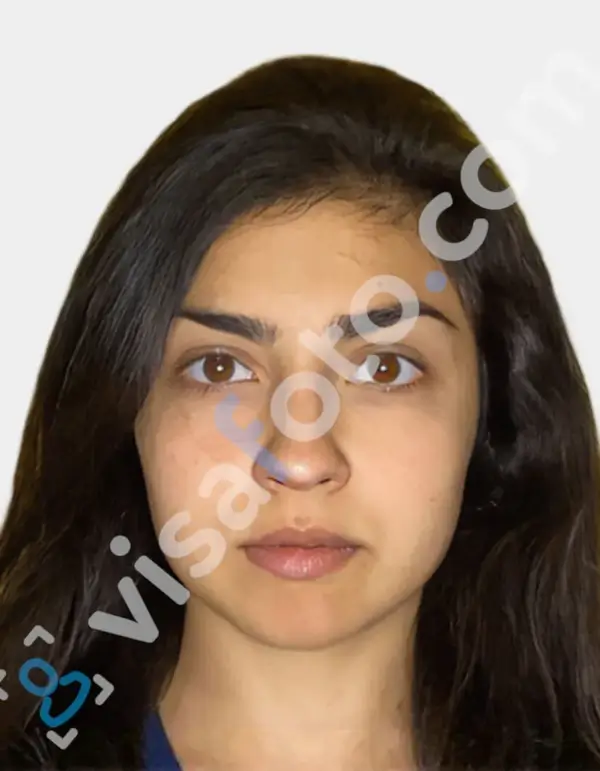
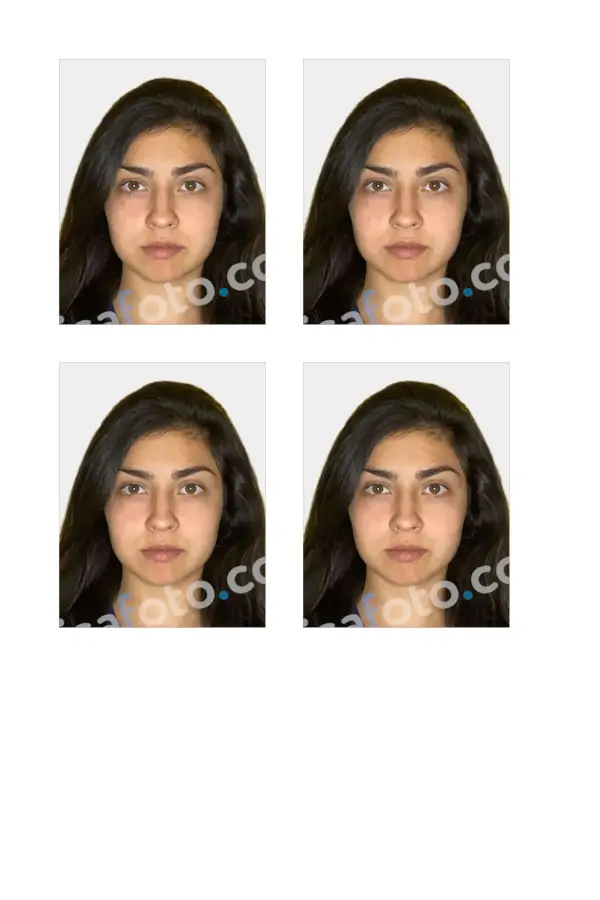
Visafoto reports a 99.7% acceptance rate and more than 1,000,000 approved photos. If your photo is rejected, you receive a full refund. Our tech support is available 24/7.
How to apply for a work permit after entering Thailand on a Non-B visa
After entering Thailand on a Non-B visa, you apply for a Work Permit through the e-Work Permit system. Your employer handles the online application, while you must visit a service center in person for biometric registration and card collection.
- Employer submits the application online. Your Thai employer registers on the e-Work Permit portal and uploads the required company and employee documents.
- Pay the fees online. The application fees are paid electronically through the e-Payment system.
- Wait for document verification. The Department of Employment reviews the application online. You receive updates through email, SMS, or LINE.
- Schedule a biometrics appointment. After approval, book an appointment online at one of the designated service centers nationwide.
- Complete biometrics and collect the card. Visit the selected center for fingerprinting and a photograph, then collect your Work Permit card. The visit typically takes less than an hour.
How long does it take to get a Non-B visa to Thailand?
Processing times for a Thailand Non-immigrant B visa depend on the embassy or consulate, the quality of your application, and whether your employer has prepared all required documents. Most applications take 5–15 working days, although cases requiring additional checks may take several weeks or longer.
Thailand work visa cost and fees
The main government costs for working in Thailand include separate fees for the Non-B visa and Work Permit. For a typical one-year employment arrangement, budget around 5,000 THB in government fees, excluding any agency or service charges. Here you'll find the cost breakdown.
Non-Immigrant B visa:
- One-year multiple entry: approximately THB 5,000
- Single entry: approximately THB 2,000
Visa fees can vary by embassy and are usually collected in the local currency.
Work Permit:
- Application fee: THB 100
- Up to 3 months: THB 750
- 3–6 months: THB 1,500
- 12 months: THB 3,000
Other common fees include:
- Extension of stay: generally THB 1,900
- Single Re-Entry Permit: THB 1,000
- Multiple Re-Entry Permit: THB 3,800
Bringing your family to Thailand on a Non-B visa
Your immediate family can join you in Thailand, but each family member needs their own immigration status. Your spouse and dependent children can generally apply for a Non-Immigrant O (Dependent) visa. The age limit for children may vary by immigration office. This visa allows them to stay in Thailand as your dependents but does not permit them to work.
Required documents typically include:
- Proof of relationship: Marriage certificate for your spouse or birth certificate for your children. Documents may need certified English translations and notarization.
- Your status documents: Copies of your passport, Non-B visa, and Work Permit or relevant application receipt.
- Financial evidence: Bank statements showing at least THB 30,000 or the equivalent for the family member.
- Application and photos: Completed visa application form and recent passport-sized photographs.
Important: A Non-O Dependent visa does not authorize your spouse or children to work. A spouse who wants to work must obtain their own employment-based Non-B visa and Work Permit.
Family members generally receive an initial 90-day permission to stay after entering Thailand. They can then apply for a stay extension of up to one year, usually aligned with the primary visa holder's extension and Work Permit. If your employment ends and you permanently leave Thailand, your dependents' immigration status may also end.
Non-B visa and work permit duration of stay and extension rules
Thailand’s Non-B visa and Work Permit follow separate validity periods, so you must keep your immigration status and work authorization up to date.
Thailand work visa duration
A Non-B visa generally allows you to stay in Thailand for up to 90 days after your first entry. This period gives you time to complete the necessary employment and work permit procedures.
Extending your stay: the 1-year rule
After obtaining a Work Permit, you can apply for a stay extension at a local Immigration Office. The extension is generally issued for one year and must be renewed each year while you remain employed.
Apply before your initial 90-day permission to stay expires. In many cases, the extension period is coordinated with the validity of your Work Permit.
Work Permit duration
A Work Permit is commonly issued for one year, but the Labour authorities may approve a different period, such as 3 or 6 months or up to 2 years, depending on the employment and supporting documents. Renew it before it expires to maintain legal authorization to work.
Re-entry permits and traveling outside Thailand
If you hold a Non-B visa or a related extension of stay and need to leave Thailand, obtain a Re-Entry Permit before departure. Without one, your current permission to stay ends when you leave the country, and you may have to apply for a new Non-B visa and restart the required work authorization procedures.
You can apply at:
- Local Immigration Office: The main option; same-day processing is usually available.
- Airport Immigration counters: Available at Suvarnabhumi and Don Mueang airports. Allow extra time if you are traveling during busy periods.
Typical requirements include:
- Passport with your current visa and extension stamps.
- Completed TM.8 application form.
- One recent 4 × 6 cm photograph.
- Re-entry permit fee: THB 1,000 for a single entry or THB 3,800 for multiple entries.
FAQ
Can I convert a tourist visa to a Non-B visa in Thailand?
Yes. You can apply for a change of visa type at the Immigration Bureau using Form TM.86. Your current permission to stay should have at least 15 days remaining, and your employer must provide the required documents. Processing usually takes about 15 days, and you cannot leave Thailand while the application is being processed.
Can I change employers on a Thailand work visa?
Yes, but you must complete the required procedures first. Your existing work permit and employment-based status must be canceled, while the new employer must arrange a new or amended work permit and the necessary immigration updates. Do not start working for the new employer until you receive authorization.
Do I have to leave Thailand to renew a Non-B visa?
No. If you hold a 90-day Non-B visa and a Work Permit, you can apply for a Non-B visa 1 year extension at an Immigration Office in Thailand. Submit the application before your current permission to stay expires, preferably 3–5 working days in advance. If you leave Thailand without a re-entry permit, your current permission to stay will be canceled.
Can I apply for a Thailand Non-B visa without a WP3?
Generally, no. A WP3 work permit pre-approval letter from the Ministry of Labour is normally required for employment-based Non-B applications, although Japanese nationals are exempt from this requirement. If you are already working in Thailand and renewing your Non-B status, you can submit your existing Work Permit instead.
Can I apply for a Non-B visa from a country where I am not a resident?
Sometimes. Thai embassies and consulates have different rules for third-country applicants. Some accept applications only from citizens or legal residents, while others may accept applicants who can prove lawful presence in the country. Check the requirements of the specific mission before applying.
What happens to my Thailand work visa if I leave without a re-entry permit?
Your current permission to stay is canceled when you leave Thailand without a re-entry permit. You cannot restore it after departure. To return, you will need to enter under another eligible status and restart the required Non-B visa and work permit procedures.
Can my children attend school in Thailand as Non-B dependents?
Yes. Children under 20 can generally attend school while holding a Non-O Dependent visa linked to a parent's Non-B status. Schools generally require a valid non-immigrant visa, such as Non-B, Non-O, or Non-ED. You will also need documents such as the child's certified and translated birth certificate and proof of the parent's work status.
How long can I stay in Thailand if my work permit is canceled?
You typically have 7 days from the work permit cancellation date to leave Thailand or arrange a new immigration status. Do not rely on the original visa expiry date: when the work permit supporting your extension is canceled, your permission to stay may also end.