India Visa For U.S. Citizens

U.S. citizens planning to visit India will need a visa, but getting one is straightforward. You can apply for an Indian e-visa online, which makes the process easier and more convenient.
Check out this comprehensive India visa guide covering everything from instructions on how to get an India visa from the USA to tips on where to get a compliant visa photo.
Table of contents
- Do U.S. Passport Holders Need a Visa for India? Detailed Visa Policy
- General India Visa Types
- India E-Visa Eligibility and Rules for U.S. Citizens
- How to Apply for an India Visa Online?
- How to Apply for an Indian Visa at the Consulate in the U.S.?
- Applying for an India Visa Via VFS in the U.S.
- How Long Does It Take to Get an India Visa from the U.S.?
- Documents Required for India Tourist Visa Application
- India Visa Photo Requirements
- Get an India Visa Photo Online
- India Tourist Visa Validity and Fees for U.S. Citizens
Do U.S. Passport Holders Need a Visa for India? Detailed Visa Policy
U.S. citizens are required to obtain a visa to enter India. Both e-visa and regular visa options are available for tourism and other travel purposes. No major policy changes have been introduced for 2026, and current rules remain consistent with the post-2022 framework for U.S. nationals.
e-Visa Options
The e-Tourist Visa is available in three validity options: 30-day (double entry), 1-year (multiple entry), and 5-year (multiple entry). For U.S. citizens, each visit allows a stay of up to 180 days, with a total annual limit of 180 days across all tourist visa categories.
Applications must be completed online through the official government portal: https://indianvisaonline.gov.in/evisa/.
Regular Visa Options
Long-term tourist visas, which can be issued for up to 10 years, allow multiple entries but still restrict each stay to a maximum of 180 days, with an overall limit of 180 days per calendar year.
Other visa categories, including business, student, and employment visas, generally follow the same 180-day per-visit rule for U.S. citizens. If a business stay exceeds 180 days within a year, FRRO registration becomes necessary.
India Visa Types: e-Visa vs Paper Visa (Regular Visa)
General India Visa Types
Depending on your visit's purpose, here are the categories you might apply for:
- Tourist visa: For those visiting India for leisure, to see family or friends, or to pursue non-business activities. Nationals from most countries can apply for this visa online.
- Business visa: Suited for business purposes, such as meeting partners, attending events, or exploring market opportunities. Generally issued for one year with multiple entries and often available online.
- Medical visa: Required for receiving treatment at recognized medical facilities in India. Typically allows up to three entries for stays up to 60 days and can be applied for online.
- Employment visa: Needed if working for an Indian employer. You must have a job offer from a registered Indian company.
- Student visa: Requires an admission letter from an Indian educational institution. A letter from a religious organization is acceptable for religious studies.
- Visa for foreigners of Indian origin: If you have Indian heritage or are married to an Indian national, you may be eligible for a five-year visa.
- Intern visa: Allows students to intern at Indian companies, NGOs, and institutions. Applicants need to apply within a year after completing their undergraduate or postgraduate studies.
- Film visa: Issued for filming movies, TV series, or documentaries in India.
- Journalist visa: Designed for journalists, photographers, and documentary filmmakers, permitting up to three months of work in India.
- Conference visa: A single-entry visa valid for 30 days to attend international conventions or seminars in India. This can be requested online.
- Research visa: For scholars intending to conduct research in India, typically valid for one year.
- Transit visa: Valid for 24 to 72 hours for those passing through India en route to another country. This cannot be obtained online, so travelers usually opt for a regular e-tourist visa for transfers in India.
India E-Visa Eligibility and Rules for U.S. Citizens
As a U.S. passport holder, you're eligible to apply for an e-Visa as long as you meet certain requirements:
- Your passport must be valid for at least six months from the date of arrival (not the date of application) and contain at least two blank pages for immigration stamps.
- Entry on an e-Visa is permitted only through 30 designated airports and 5 seaports. Entry via land borders is not allowed.
- FRRO registration is required only if a traveler exceeds 180 days of stay in a calendar year on tourist visas or falls under specific long-term visa categories (such as business stays exceeding 180 days in total). Registration must be completed within 14 days of arrival.
- Diplomatic and official passport holders are not eligible for e-Visas, and applications are also not accepted from individuals of Pakistani origin.
- Applications should be submitted between 4 and 120 days before travel through the official portal: indianvisaonline.gov.in/evisa/.
e-Visa Types
- e-Tourist Visa: Available for 30 days (double entry), or 1-year and 5-year validity (multiple entry). Each stay is limited to 180 days, with a combined annual cap of 180 days across all tourist visa types.
- e-Business Visa: Issued for 1 year with multiple entries. Each stay may last up to 180 days, and FRRO registration is required if total business stay exceeds 180 days in a year.
- e-Medical Visa: Valid for 60 days and allows triple entry.
- e-Conference Visa: Valid for 30 days with single-entry permission.
e-Visas cannot be extended or converted to other visa types. Overstaying may result in penalties, fines, or future entry restrictions.
How to Apply for an India Visa Online?
Here's how to get for e-visa for India from the U.S:
- Head to the official Indian e-Visa website. Be cautious of commercial sites posing as the official portal, often charging extra fees. The legitimate site ends with ".gov."
- Click on the "e-Visa Application" section in the menu.
- Select the e-Visa type you need — such as tourist, business, medical, or conference — based on your travel purposes.
- Fill out the online form with the necessary details, including your personal information, passport data, and travel plans.
- Upload scans of your passport's bio page and a recent passport-sized photo.
- Pay the visa fee using a credit/debit card or an electronic wallet.
- Track your application's progress through the website by selecting 'Check Your Visa Status.'
- Once approved, you will get an Electronic Travel Authorization (ETA) via email. Print out the e-Visa and carry it with you when you travel to India. You must present this printout at the immigration checkpoint in India, where your passport will be stamped with the visa.
How to Apply for an Indian Visa at the Consulate in the U.S.?
Here's how you can apply for an Indian visa from the USA through a consulate:
- Start by visiting the official website of the Indian embassy or consulate you’ll be applying to. Options for U.S. residents include the Indian Embassy in Washington, D.C., Consulate in New York, Consulate in San Francisco, Consulate in Chicago and Consulate in Houston.
- Complete the online visa application form available on the embassy's website. Make sure all details are accurately filled in. Once submitted, print a copy and sign it where necessary.
- Gather all required documents to support your visa application. Information on the necessary documents is provided below in the article.
- Book an appointment for your application submission and biometric collection (fingerprints and photos).
- On the day of your appointment, bring the signed application form and all required documents to the consulate for submission in person.
- Pay the relevant visa fee during your appointment.
- After your application is submitted, you can track its progress on the consulate’s website or via any tracking system offered during your appointment.
- Once your visa for US is processed, you’ll be notified when it is ready for pickup or if it will be mailed to you.
Applying for an India Visa Via VFS in the U.S.
If you do not live near an Indian embassy or consulate, applying through a VFS Global center is usually the most practical option. Regular (non-eVisa) Indian visa applications for U.S. residents are processed through VFS centers assigned to specific Indian consular jurisdictions, so your first step is to confirm which consulate serves your state. Once confirmed, begin the process at least 4–6 weeks before your planned travel date.
When to apply
Most regular Indian visas take around 5–15 business days to process, but delays are common during peak travel periods or when additional verification is required. Applying 4–6 weeks in advance gives you a comfortable buffer.
VFS centers generally operate Monday through Saturday from 9:00 AM to 3:30 PM. Booking an appointment online is strongly recommended to avoid unnecessary delays. In urgent situations, such as a family emergency, expedited visa options may be available directly through the relevant Indian consulate.
Step-by-step application process
- Check your consular jurisdiction: Verify which Indian embassy or consulate covers your state through the official Indian Embassy website or your regional consulate page.
- Complete the online application: Fill out the visa form through VFS Global, upload the required documents, and pay all applicable fees, including visa charges, service fees, and optional courier services.
- Book your appointment or mail your documents: You can either schedule an in-person submission at your nearest VFS center or send your application package by mail with a prepaid return label. Most applicants providing in-person submissions will complete biometrics on site.
- Track your application: After submission, monitor your visa status through the VFS portal or email updates. Once approved, your passport will be returned by courier or made available for pickup.
For assistance, VFS Global operates a customer support line at +1-800-320-9693 (Monday to Saturday, 9:00 AM–8:00 PM EST). Always use official VFS and Indian government websites when applying, as unofficial third-party services frequently charge unnecessary fees.
How Long Does It Take to Get an India Visa from the U.S.?
Most regular visa most applications take 5–15 business days once courier transit and document handling are factored in.
For tourist and business visas, U.S. applicants are generally advised to apply 4–6 weeks before travel. This allows extra time for public holidays, possible police verification, and consular workload fluctuations.
Some VFS centers offer premium lounge services that can speed up document submission and improve convenience, but they do not guarantee faster visa approval. Processing ultimately depends on the relevant Indian consulate, and no embassy or consulate provides fixed turnaround guarantees.
Documents Required for India Tourist Visa Application
Whether applying for an Indian tourist visa online or through a VFS center, U.S. applicants must prepare several essential documents. The exact requirements vary slightly between e-Visas and regular paper visas, but the core documentation remains largely the same.
Application form: For regular visas, applicants must complete, print, and sign the online application form through indianvisaonline.gov.in. e-Visa applicants complete the same process digitally and submit everything online.
Valid passport: Your passport must remain valid for at least six months from your intended date of arrival in India and include at least two blank pages. A photocopy of the biographical information page is usually required as well.
Passport photo: A recent passport-style photograph is required. For most applications, this means a 2x2-inch photo with a plain white background. e-Visa submissions require a digital JPEG file, while regular visa applications may also require printed copies.
Travel details: Applicants are typically asked to provide intended travel dates, proof of accommodation such as hotel reservations, and either round-trip flight bookings or a planned itinerary. Fully purchased flight tickets are usually not mandatory at the application stage.
Financial proof: Some applicants may need to provide recent bank statements to demonstrate sufficient funds for the trip, although this is often not requested for straightforward short-term tourist visits.
Additional documents for minors: Applications for children generally require a birth certificate, copies of both parents’ passports, and, when applicable, a notarized consent letter if one parent is not traveling or participating in the application process.
Previous India travel records: If you have previously visited India, you may need to provide details of earlier visas or copies of OCI/PIO documentation.
For most e-Visa applications, only a passport scan and digital photo are uploaded online. Regular visas submitted through VFS usually involve a fuller document package and may also require supporting materials such as a cover letter. Since requirements can vary by consular jurisdiction, it is always best to verify the latest checklist on the official VFS or Indian consulate website before applying.
India Visa Photo Requirements
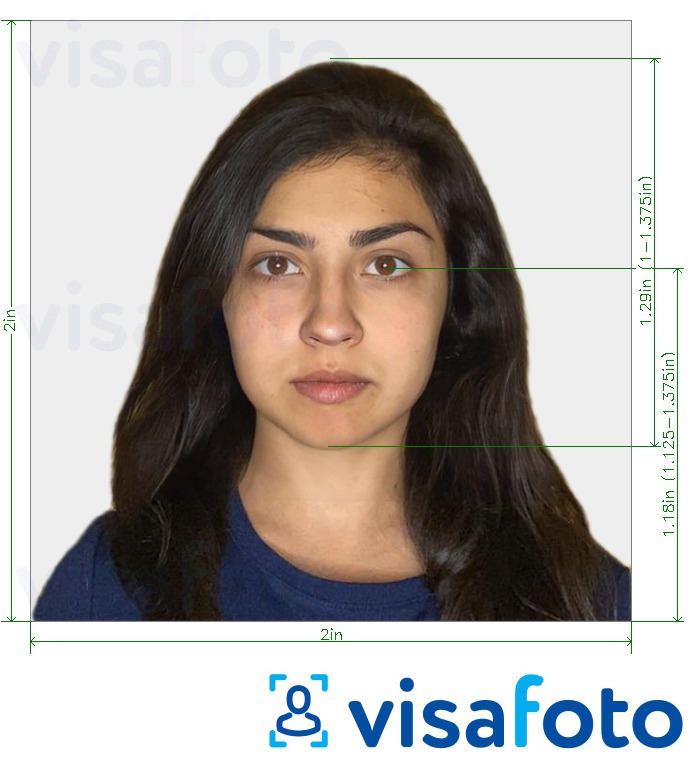
When applying for an Indian visa, whether online or at the consulate, you must attach a compliant passport sized photo. Here are the specifications you need to follow:
- The printed photo size must be 2×2 inches (51 × 51 mm).
- Digital photo for e-Visa requires a square photo with a minimum size of 190×190 pixels, saved in JPEG format.
- The photo must be in color.
- Use a plain white background without shadows or objects.
- The head should be centered, capturing the full face from the top of the hair to the bottom of the chin.
- The head should take up 1 inch to 1-3/8 inches (25 mm to 35 mm) of the frame, with eye height between 1-1/8 inches to 1-3/8 inches from the bottom of the chin.
- Maintain a neutral expression and look directly at the camera.
- Ensure there are no harsh shadows or overexposed spots on your face.
- Wear solid-colored clothing that is not white or patterned.
- If you wear glasses, make sure there's no glare and they don't cover your eyes. Tinted glasses aren’t allowed.
- Religious head coverings are allowed, but facial features from the chin to the forehead, and the edges of the face must be visible.
Here is an example:
Get an India Visa Photo Online
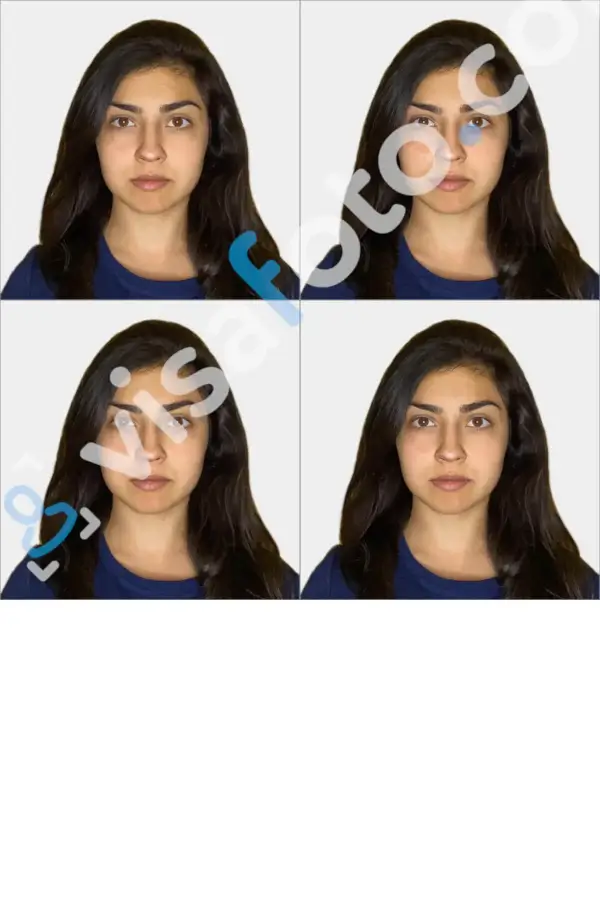
To streamline your India visa application, consider getting your photo taken online. Services like Visafoto can ensure your photo meets all requirements without the need for a photo studio visit. Established in 2013, Visafoto specializes in preparing document photos for visas, passports, and other identification, tailored to specific country requirements.
Simply capture a photo of yourself that follows the outlined guidelines and upload it to the tool provided. Visafoto will adjust the format, background, and dimensions for you. Plus, if you're not happy with the initial result, we offer free replacements, and we provide a full refund if your photo isn't accepted.
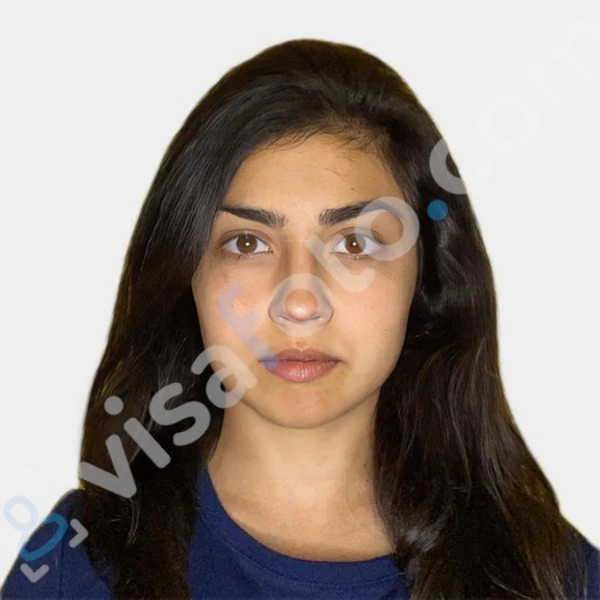
You’ll receive both a digital version, suitable for online applications, and a print-ready file.
It should look like this:
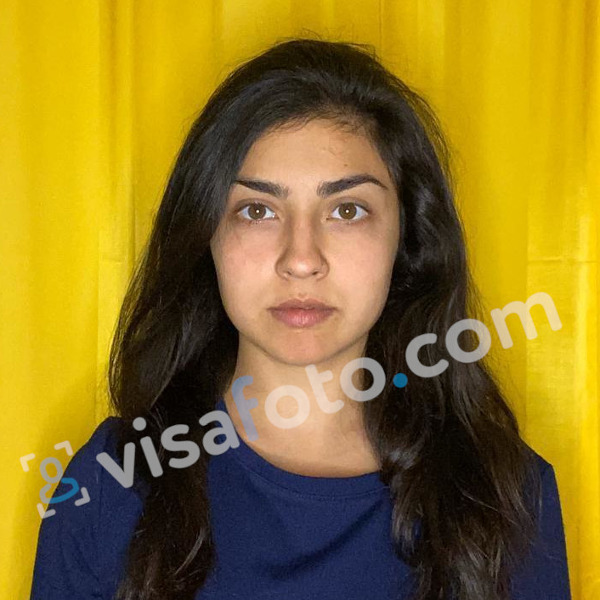
You will get two types of photos: a digital one for electronic submission and a template for printing.
India Tourist Visa Validity and Fees for U.S. Citizens
U.S. citizens traveling to India can choose between an e-Tourist Visa and a regular tourist visa issued through VFS Global and Indian consulates. The best option depends on how long you plan to stay, how often you expect to visit, and whether you prefer a fully online application or a traditional visa sticker in your passport.
The fees below reflect standard government charges for 2026. Keep in mind that regular visa applications usually include additional VFS service and ICWF fees, which typically add around $32–45 to the total cost.
e-Tourist Visa
The e-Tourist Visa is the faster and more convenient option for most short-term travelers. Applications are submitted online through indianvisaonline.gov.in/evisa.
-
30-day e-Tourist Visa: Costs approximately $25 and allows double entry. Travelers may remain in India for up to 30 days.
-
1-year e-Tourist Visa: Costs around $40 and permits multiple entries. Each stay can last up to 180 days, with a combined annual stay limit of 180 days.
-
5-year e-Tourist Visa: Costs approximately $80 and also allows multiple entries, with the same 180-day per-visit and annual stay restrictions.
Regular tourist visa
Regular tourist visas are issued through VFS centers and Indian consulates and may be valid for significantly longer periods, making them a practical choice for frequent travelers.
-
6-month visa: Usually starts at about $100, plus service fees.
-
1-year visa: Typically costs around $150, plus additional processing charges.
-
5-year visa: Usually priced at approximately $200, excluding VFS fees.
-
10-year visa: Generally costs around $250 plus service charges and is often the preferred option for travelers who visit India regularly.
Although regular visas may remain valid for several years, U.S. citizens are generally still limited to stays of up to 180 days per visit, with a total maximum stay of 180 days per calendar year under tourist status.
Overstaying any Indian tourist visa can lead to fines, exit complications, or future entry restrictions. Because visa fees occasionally change and can vary slightly by consular jurisdiction, it is always worth checking the latest pricing directly through your assigned Indian consulate or the official VFS website before applying.
FAQ
Can I get an Indian Visa on Arrival?
No. U.S. citizens are not eligible for visa-on-arrival entry to India. All travelers must obtain either an e-Visa online or a regular visa through VFS Global or an Indian consulate before departure. The United States is among the countries eligible for India’s e-Visa program.
Can I apply for an Indian visa with an expiring passport ?
Your passport must remain valid for at least six months beyond your planned arrival date in India and contain at least two blank pages. If your passport does not meet these requirements, you will need to renew it before applying. e-Visa applications require a digital passport scan, while regular visa applications require submission of the physical passport through VFS.
How do I check my e-Visa or visa status online?
e-Visa applications can be tracked through indianvisaonline.gov.in/evisa using your application ID and passport number. If you applied for a regular visa, you can check your status through VFS Global using your reference number. Most applicants also receive status updates by email.
Can I extend my Indian tourist visa or e-Visa?
No. Indian tourist visas and e-Visas generally cannot be extended or converted while you are in India. If an emergency such as a medical issue prevents departure, you may request assistance or an exit permit through the FRRO. Overstaying can result in substantial fines and may affect future visa eligibility.
What happens if my Indian visa application gets rejected?
Applications are commonly refused because of incomplete documentation, incorrect information, previous immigration violations, or security-related concerns. There is no formal appeal process, but applicants can usually reapply after correcting the issue. Repeated refusals may trigger closer scrutiny on future applications.
Is travel insurance required for Indian visa?
Travel insurance is not officially required for an Indian e-Visa or tourist visa. However, it is strongly recommended, especially for medical coverage and unexpected travel disruptions. Since healthcare standards and private medical costs vary across India, many travelers choose policies with at least $50,000 in emergency medical coverage.
Last update: May 2026