UK Blue Badge application and photo requirements

A Blue Badge helps disabled people park closer to their destination, whether they drive or travel as a passenger. You can apply for yourself or help someone else apply, but the eligibility rules and application arrangements depend on where you live in the UK.
This guide explains the criteria, supporting documents, photo requirements and application steps. It also covers fees, printable application forms and what happens after you submit your application.
Contents
- What is a Blue Badge?
- Who qualifies for a Blue Badge?
- What medical conditions qualify for a Blue Badge?
- Documents required for a Blue Badge
- Prepare your Blue Badge photo online with Visafoto
- How to apply for a Blue Badge online
- Where to get a Blue Badge application form to print off
- Blue Badge fees and processing times
- What happens after you apply?
- Renewing or replacing a Blue Badge
- Using your Blue Badge
- Frequently asked questions
- Blue Badge application checklist
What is a Blue Badge?
A Blue Badge is a disabled person's parking permit. It gives eligible people access to parking concessions that can make journeys more manageable, particularly when walking from a distant parking space would be difficult or unsafe.
An individual badge belongs to the person, rather than a particular car. You do not need to own a vehicle or hold a driving licence to apply. You can use your badge when someone else drives you, subject to the rules for its use.
Local councils administer applications in England, Scotland and Wales. In Northern Ireland, the Department for Infrastructure's Blue Badge Unit runs the scheme. A badge does not mean that every car park is free or that every parking restriction can be ignored.
If you are also arranging accessible travel, our guides to the UK disabled person's bus pass and London Freedom Pass cover those separate schemes.
Who qualifies for a Blue Badge?
UK Blue Badge criteria include both routes based on specified benefits or sight impairment and routes that require an assessment of how your disability affects you. You still need to apply and provide evidence even if you qualify without a further mobility assessment.
Eligibility in England
In England, people aged three or over qualify without further assessment if they meet one of these criteria:
- Receive the higher rate of the mobility component of Disability Living Allowance (DLA).
- Receive Personal Independence Payment (PIP) with at least eight points for the "moving around" activity.
- Receive PIP with exactly 10 points under descriptor E of "planning and following journeys", because undertaking any journey would cause overwhelming psychological distress.
- Are registered blind, also described as severely sight impaired.
- Receive the War Pensioners' Mobility Supplement.
- Have a qualifying Armed Forces Compensation Scheme award within tariff levels 1 to 8 and the required certification of a permanent and substantial disability causing inability to walk or very considerable difficulty walking.
The PIP journey rule is specific: another descriptor, including an award of 12 points, does not automatically qualify you through England's 10-point route. You may still qualify following assessment.
You can also apply if you do not receive a qualifying benefit. Assessed routes include inability to walk, very considerable difficulty walking, journeys that could seriously endanger your health or safety, or very considerable difficulty during journeys because of a non-visible disability. A separate route covers regular drivers with severe disabilities in both arms who cannot operate parking meters.
Differences in Scotland, Wales and Northern Ireland
Use the criteria for the country where you live. For example, Wales includes 12 points for PIP's "planning and following a journey" activity in its automatic qualification rules, whereas England's corresponding route uses the specific 10-point descriptor above.
Wales also has a temporary 12-month badge route for certain serious illnesses or injuries with a substantial effect on mobility. An ordinary short-term sprain or fracture does not qualify simply because it makes walking inconvenient.
In Scotland, applications based on a person being at risk in traffic must go directly through the council rather than the standard online application. Northern Ireland has its own application service and eligibility assessment. Do not assume that an English benefit threshold applies throughout the UK.
Can a child under three get a Blue Badge?
There are special provisions for very young children. In England and Wales, a child under three may qualify if their condition means they must travel with bulky medical equipment that is difficult to carry, or must remain near a vehicle for urgent treatment or rapid transport to treatment.
This is different from the usual walking assessment for an older child. Explain the child's medical needs and supply the evidence requested for that route.
What medical conditions qualify for a Blue Badge?
There is no single UK-wide list of diagnoses that guarantees a Blue Badge. Unless you qualify through a specified benefit or another qualifying category, the assessment concerns the effect of your condition on walking or making journeys.
Arthritis, multiple sclerosis, Parkinson's disease and other physical conditions may cause substantial walking difficulties. Autism, dementia or a mental health condition may affect journey planning, safety or psychological distress. Having one of these diagnoses does not, by itself, establish eligibility.
Describe what actually happens on a journey. For example, explain how far you can walk before stopping, the pain or breathlessness involved, the help you need, or situations where you are at serious risk near traffic. If your symptoms vary, explain that variation rather than describing only your best day.
Relevant evidence might include an existing specialist report, care plan or assessment that describes these difficulties. Ask the issuing authority what it needs before paying for a new medical letter. If you have a terminal illness, tell the authority at the outset, as a separate or faster application route may be available.
Documents required for a Blue Badge application
Prepare clear photos or scans of your supporting documents before starting an online application. The exact evidence depends on the country, your eligibility route and whether this is a first application or renewal.
The basic Blue Badge checklist includes:
- Proof of identity, such as a passport, birth certificate or driving licence.
- Proof of address, such as a council tax bill or government letter accepted by the issuing authority.
- Evidence of a qualifying benefit or sight impairment, if applying through that route. Include the relevant award details, points and award dates, rather than only a payment notification.
- Information about your disability and its effects, with supporting evidence where requested for an assessed application.
- A recent head-and-shoulders photograph of the applicant.
- Your National Insurance number, if you have one, and your existing badge details if renewing.
- Contact details for the person helping you, if someone else is completing the application.
For a child's application, provide the child's information and the parent or guardian details requested by the form. A carer completing the form must use the applicant's portrait, not their own.
Blue Badge photo requirements: size, glasses and uploading
A Blue Badge photo must make the holder easy to identify. The Department for Transport's photo guidance for England gives the following specifications. Other UK countries and individual application services may give their own submission instructions.
| Photo requirement | England's guidance |
|---|---|
| Blue Badge photo size | 35 mm wide × 45 mm high |
| Photo age | Taken within the month before the application |
| Composition | A close-up of the full head and shoulders, with no other person visible |
| Colour and background | Colour photograph with a light grey or cream background |
| Position and expression | Face forward, look at the camera, keep a neutral expression and close your mouth |
| Eyes | Open and clearly visible, unobstructed by hair or spectacle frames |
| Glasses | No sunglasses or tinted spectacles; no glare or reflections obscuring the eyes |
| Head coverings | Allowed for religious or medical reasons, with the face visible |
| Image quality | Sharp and clear, without red-eye, shadows, damage or glare; a true likeness of the applicant |
| Submission | A digital image or professionally printed photograph, according to the application method |
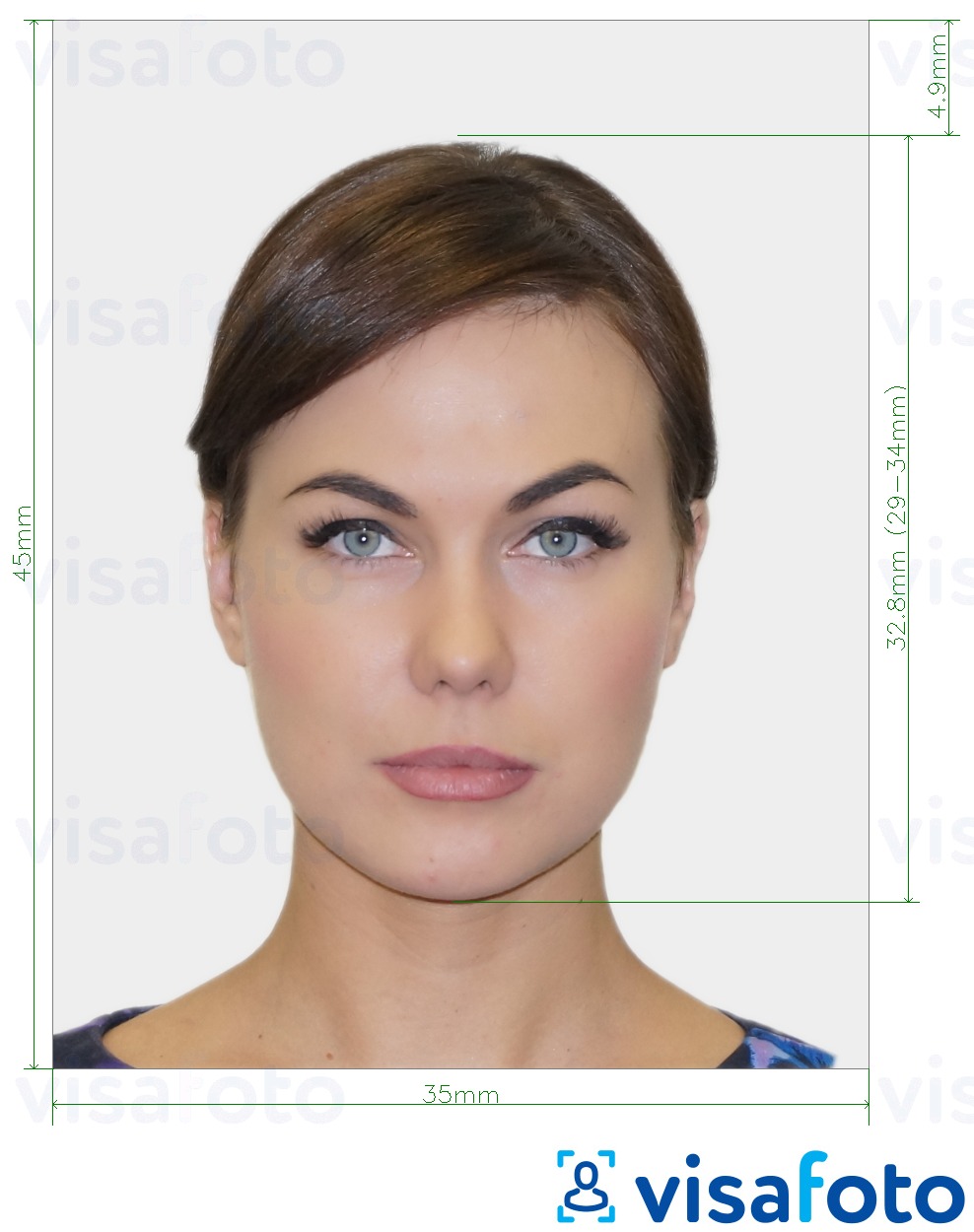
The example illustrates the 35 × 45 mm photo format, rather than a Blue Badge itself.
Should you take a Blue Badge photo with or without glasses? Ordinary clear glasses can stay on if the eyes remain fully visible and there are no reflections. Taking them off is often the easiest way to avoid glare, provided you can do so comfortably.
You can have someone take the photo at home. Sit in a comfortable, supported position and have the camera at eye level. You do not need to stand or visit a photo booth. If your disability prevents you from meeting a requirement, explain this to the council or Blue Badge Unit and ask what alternative photograph it can accept. Do not put yourself at risk trying to hold an unsuitable position.
For a Blue Badge photo upload, physical dimensions and file limits are different things. England's 35 × 45 mm specification does not establish a universal UK pixel count or maximum file size. Northern Ireland's online service, for example, specifies a maximum photo file size of 5 MB. Use the individual portrait file for an online application, rather than a sheet containing several copies.
If the upload fails, check the file extension and size against the form's displayed limits. A phone's HEIC image may need conversion if the service does not accept it. Reducing file size should not make the face blurred or pixelated. Avoid submitting a screenshot of the portrait, as it may include borders or lose detail. For paper applications, supply the requested print and follow any instructions for writing the applicant's details on the back.
Prepare your Blue Badge photo online with Visafoto
Getting to a photo booth or arranging a studio visit can be an unnecessary extra journey. With Visafoto, you can prepare your Blue Badge photo from a photograph taken at home, with help from a friend, relative or carer if needed. Stay seated in your usual chair or wheelchair and take the photo when you feel comfortable.
You do not need to arrange a perfect background before taking the source photo. Visafoto can replace the background, adjust the crop and framing, and improve lighting, contrast and image quality while preserving your facial features. Keep your full head and shoulders in the original picture so there is enough room to prepare the final image.
To get your photo ready:
- Ask someone to take a clear, front-facing photograph with a phone or camera at eye level. Take a few shots so you can choose one where your eyes are visible and your expression is relaxed and neutral.
- Upload your chosen photograph to Visafoto. For the 35 × 45 mm format, select the UK passport photo option, which Visafoto also lists as suitable for a Blue Badge.
- Download the prepared digital portrait for an online application, or the printable layout if you need a paper photograph.
- Check the issuing authority's upload limits before submitting. For a printed application, print at actual size and check that each cut photograph measures 35 × 45 mm. Choose paper matching the supplied layout and turn off any option that stretches it to fill the page.
If disability-related positioning or an upload problem makes the photo difficult to prepare, Visafoto's experienced support team can review your case individually. Human support is available 24/7. If a photo purchased from Visafoto is rejected by the issuing authority, you can request a 100% refund.
Visafoto prepares the photograph; your council or the Blue Badge Unit handles the application and decides eligibility.
How to apply for a Blue Badge online
For most applications in England, Scotland and Wales, start with the official GOV.UK Blue Badge application service. Northern Ireland residents should use the separate nidirect Blue Badge service. In Scotland, contact the council directly for an application based on being at risk in traffic.
- Choose the correct applicant and location. Confirm whether you are applying for yourself or helping someone else, and enter the applicant's address.
- Answer the eligibility questions. Give the relevant benefit details or explain how the person's disability affects walking and journeys.
- Enter personal and contact information. Use details that match the identity documents. Add existing badge information if renewing.
- Upload the evidence and portrait. Make sure documents are readable and complete, including the relevant pages of benefit letters.
- Review the application. Check dates, contact details and attachments before submitting. Include enough detail for the authority to understand the difficulties described.
- Save the confirmation or reference. Follow the issuing authority's payment instructions and keep any acknowledgement so you can follow up.
The GOV.UK application allows you to save your progress and return later. Northern Ireland's current online application must be completed in one session, so have your files and payment card ready before starting.
Where to get a Blue Badge application form to print off
There is no single paper Blue Badge application form for the whole UK. Request the current form from your local council, or from the Blue Badge Unit in Northern Ireland. Scotland's official guidance expressly allows applicants to ask their council for a paper form.
Some councils publish downloadable forms. For example, North East Lincolnshire Council's Blue Badge page includes a printable Word application form for its residents. Use your own authority's form, since questions, evidence requirements and return addresses can differ.
Before posting it, check that you have signed the declaration, enclosed the requested evidence and photograph, and used the stated return address. Keep a copy of the completed application. A general information leaflet or eligibility checklist is not a substitute for an application form.
If completing a form is difficult, ask the authority about help by phone, assisted applications or accessible formats. A relative or carer can also help you apply.
Blue Badge fees and processing times
The official issue fee depends on the country. Preparing a photo through a commercial service is a separate purchase from applying for the badge.
| Country | Badge fee | Processing guidance |
|---|---|---|
| England | Up to £10 | GOV.UK says councils usually decide within 12 weeks, but waiting times vary |
| Scotland | £20 | Most councils take around 12 weeks; some applications take longer |
| Wales | Free | Allow for your council's processing time; there is no guaranteed UK-wide deadline |
| Northern Ireland | £10 | Usually 6 to 8 weeks from receipt; longer if more information is needed |
Missing evidence, a further assessment or a photograph that needs replacing can delay a decision. Apply well before you need the badge, and do not assume that submitting an application gives you parking concessions while you wait.
What happens after you apply?
The issuing authority checks your identity, evidence and eligibility. It may ask for additional documents, clarification of an answer or a mobility assessment before reaching a decision.
If the application is refused, read the reasons carefully. The review procedure depends on the issuing authority. In Wales, there is no formal appeal process, but you can ask the council to reconsider if you have additional evidence. In England, GOV.UK advises contacting the council if you believe it has overlooked important information.
If the problem is the photo rather than eligibility, ask what needs correcting and submit a replacement through the method requested. Keep the application reference with your correspondence.
Renewing or replacing a Blue Badge
Blue Badges usually last up to three years, although a shorter period can apply. Renewal is not automatic: reapply before the expiry date and allow time for a decision. Your authority may need updated evidence and a new photograph.
Replacing a lost, stolen or damaged badge is a different task from renewing one that is expiring. GOV.UK directs applicants to a separate replacement service when the badge is not due to expire within the next three months. Northern Ireland also has a separate replacement process.
An expired badge cannot be used simply because a renewal application is pending.
Using your Blue Badge
Read the parking guidance supplied with the badge and check signs wherever you park. Private car parks, hospitals and some local parking schemes have their own terms; the badge does not guarantee free parking everywhere.
Use an individual badge only for journeys connected with the badge holder, in accordance with the scheme's rules. Someone else cannot borrow it for their own shopping trip. Display the badge and any parking clock as instructed, and keep the badge legible and within its expiry date.
Frequently asked questions
Can I get a Blue Badge without PIP?
Yes, receiving PIP is not the only eligibility route. You may qualify through another specified benefit, sight impairment or an assessment of how your disability affects walking or journeys. The applicable criteria depend on where you live.
Can a carer apply for someone who does not drive?
Yes. You can help someone apply, and the applicant can qualify as a passenger. Supply their details, evidence and photograph. The badge belongs to the eligible person, not the carer.
Can I take my Blue Badge photo on a phone?
Yes, a clear phone photograph can be suitable. Have someone photograph you at eye level, with your full head and shoulders visible. Prepare the image to meet the relevant photo rules and upload limits before submitting it.
Can I reuse my passport photo for a Blue Badge?
Only if it meets the current Blue Badge requirements, including recency. England's guidance specifies a photo taken within the month before the application, so an older passport photo may be unsuitable even if it still looks like you.
What if my disability prevents me from meeting the photo rules?
Contact the issuing authority and explain the specific difficulty. It can advise on alternative arrangements or evidence. Do this before attempting an uncomfortable or unsafe position, and do not assume a disability-related exception will be recognised without explanation.
Can I use a Blue Badge while waiting for approval?
Submitting an application does not give you the right to use Blue Badge parking concessions. If renewing, you can continue using your existing badge only while it remains valid and under its usual conditions.
Blue Badge application checklist
- Confirm the eligibility rules for your UK country and application route.
- Gather identity, address and any required benefit or disability evidence.
- Prepare a current head-and-shoulders photo and check its size and upload format.
- Have your National Insurance number and existing badge details available, where applicable.
- Use the official online service or your issuing authority's current paper form.
- Check the declaration, attachments and contact details before submitting.
- Keep the reference number and respond promptly to requests for further information.
Last updated: 19 November 2026.
